
13 min read
Yield on Cost vs Cap Rate: How Developers Evaluate Project Profitability
Written on August 20, 2026 By Ron McVaney
Ready to start investing in Texas real estate?
Book Your Free Call Today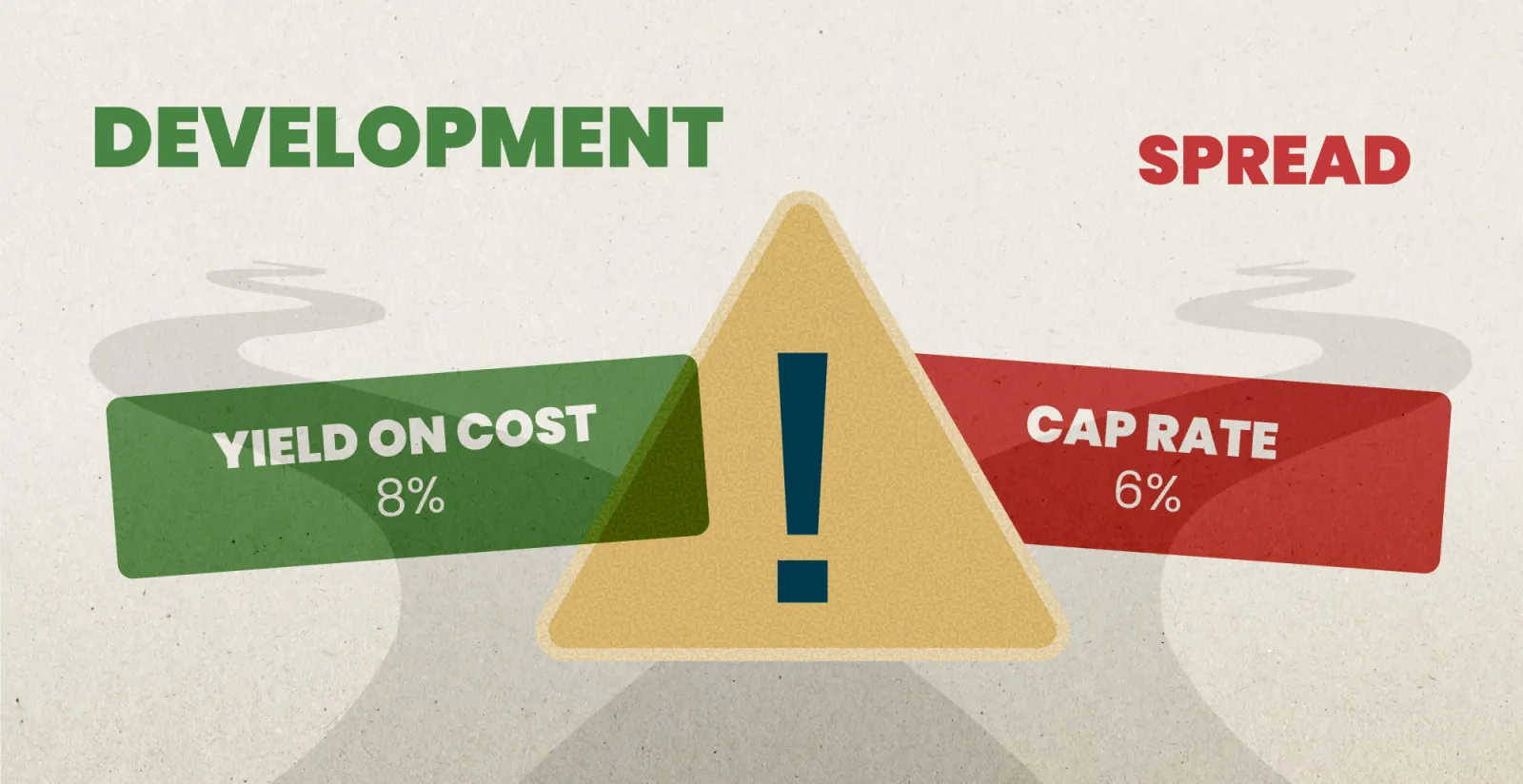
When a developer decides whether to build a new commercial project, they're not guessing. They're running specific calculations that tell them whether a project makes financial sense before a single shovel hits the ground.
Two numbers sit at the center of that analysis: the cap rate and yield on cost. You've already learned what cap rates are and how they function as the universal language of commercial property valuation. Yield on cost is the developer's companion metric—the number that tells them whether building something new is actually worth doing compared to simply buying something that already exists.
Understanding how these two metrics relate to each other, and what the gap between them means, is fundamental to understanding how Texas commercial real estate developments get evaluated, approved, and financed. It also reveals something important about how land investors like FISYN fit into the development ecosystem.
A Brief Recap: What Cap Rates Tell Us
Before diving into yield on cost, a quick recap of cap rates provides the necessary foundation.
A cap rate measures the relationship between a property's net operating income (NOI) and its market value. Divide the NOI by the property's value, and you get the cap rate. A property generating $100,000 in NOI valued at $2 million has a 5% cap rate.
Cap rates reflect market risk and investor expectations. Lower cap rates indicate safer, more desirable properties in strong markets. Higher cap rates indicate riskier properties or weaker markets where investors require higher returns.
Most importantly for this discussion: cap rates tell you the yield that existing, income-producing properties are generating in the market right now. They're the benchmark against which developers measure whether building something new makes financial sense.
What Yield on Cost Is
While cap rates measure the yield on existing properties, yield on cost measures the yield a developer expects to achieve on a new development project relative to what it costs to build.
Think of yield on cost as asking this question: if I spend everything it takes to build this project from scratch, what percentage return will I get on that total investment once the project is complete and generating income?
The answer to that question is the yield on cost.
The Yield on Cost Formula
The formula is straightforward:
Yield on Cost = Projected NOI divided by Total Development Cost
Total development cost includes everything required to deliver the completed project: land acquisition, construction costs, professional fees (architects, engineers, attorneys), financing costs during construction, permits and entitlement costs, and any other expenses incurred from project inception to completion.
Projected NOI is the income the completed project is expected to generate once it's built and stabilized—meaning it's leased up and operating normally.
Illustrative Example: Calculating Yield on Cost (For Illustration Purposes Only)
A developer is evaluating a new office park development in a Texas growth corridor.
Total development costs:
- Land acquisition: $2,000,000
- Construction costs: $6,500,000
- Architecture and engineering fees: $500,000
- Permits and entitlements: $200,000
- Financing costs during construction: $600,000
- Contingency reserve: $200,000
- Total development cost: $10,000,000
Projected NOI once the project is complete and fully leased:
- Annual rental income: $1,100,000
- Operating expenses: $300,000
- Projected NOI: $800,000
Yield on Cost: $800,000 divided by $10,000,000 = 8%
The developer's yield on cost is 8%. But what does that 8% actually mean? Is this project worth building? That's where the relationship between yield on cost and cap rates becomes critical.
The Development Spread: Where Profitability Lives
The development spread is the gap between yield on cost and the prevailing market cap rate for similar completed properties. This gap—measured in percentage points or basis points—is the single most important indicator of whether a development project is financially viable.
The fundamental rule is simple: yield on cost must be higher than the market cap rate for a development project to make economic sense.
Why the Spread Must Be Positive
Here's the logic, explained simply.
The market cap rate tells you what investors are paying for existing properties that are already built, leased, and operating. If similar office properties in the market trade at a 6% cap rate, that means investors are paying roughly 16.7 times the annual NOI for those properties ($100,000 NOI at 6% cap rate = $1,666,667 value).
If a developer can build a similar property at an 8% yield on cost, they're creating a property for less than what investors would pay for it. The project costs $10 million to build but will be worth more than $10 million once complete—because the market values it at the 6% cap rate, not the 8% yield on cost.
That value gap—the difference between what it costs to build and what it's worth once built—is the developer's profit.
Illustrative Example: Understanding the Spread (For Illustration Purposes Only)
Continuing with the office park development from the previous example:
Yield on cost: 8%
Market cap rate for similar completed office properties: 6%
Development spread: 200 basis points (2%)
At the 6% market cap rate, the completed project with $800,000 NOI is worth:
$800,000 divided by 0.06 = $13,333,333
The developer spent $10,000,000 to build a project worth $13,333,333. The 200 basis point development spread created $3,333,333 in value—that's the return on the development, before accounting for any other factors.
This is how development creates wealth: by building assets at a yield on cost that exceeds market cap rates, developers produce properties worth more than they cost to create.
What Happens When the Spread Narrows
Development spreads don't stay constant. They compress when construction costs rise, when market cap rates fall, or both. Understanding what happens as spreads narrow helps investors evaluate market conditions and development risk.
Rising Construction Costs
When materials, labor, and land costs increase, the total development cost rises. Higher total development cost means lower yield on cost for the same projected NOI.
For illustrative purposes only: if construction costs in the previous example increase by $1,000,000, total development cost becomes $11,000,000.
New yield on cost: $800,000 divided by $11,000,000 = 7.3%
With the market cap rate still at 6%, the development spread has narrowed from 200 basis points to 130 basis points. The project is still profitable, but less so than before. Developers must now work harder to find land at lower prices, cut costs elsewhere, or achieve higher rents to restore the spread.
Falling Cap Rates
Counterintuitively, falling cap rates are good news for developers even though they mean investors are accepting lower returns on existing properties. Here's why: falling cap rates increase the value of the completed project relative to its cost.
For illustrative purposes only: if market cap rates for similar office properties fall from 6% to 5.5%:
Value of completed project at 5.5% cap rate: $800,000 divided by 0.055 = $14,545,455
The same project now generates even more value on the same $10,000,000 development cost. The spread has widened from 200 basis points to 250 basis points, and the profit has grown from $3,333,333 to $4,545,455.
This relationship explains why periods of falling cap rates—driven by strong investor demand for commercial real estate—tend to stimulate development activity. Developers can achieve better spreads, making projects more profitable and attracting more capital into new construction.
What Happens When the Spread Disappears or Goes Negative
The most important boundary in development economics is when yield on cost equals or falls below the market cap rate. At this point, development stops making economic sense.
When Yield on Cost Equals Cap Rate
If yield on cost equals the market cap rate, the developer has created a property worth exactly what it cost to build—no more, no less. There's no profit from the development itself. The only potential return comes from income during the holding period and any future appreciation.
In this scenario, a developer might as well buy an existing property rather than take on the additional risk, time, and complexity of building from scratch. Development risk—construction delays, cost overruns, market shifts during the building period—is real. If there's no spread to compensate for that risk, development isn't worth pursuing.
When Yield on Cost Falls Below Cap Rate
If yield on cost falls below the market cap rate, the developer would be creating a property worth less than it costs to build. This is a loss-making scenario before the project even opens.
For illustrative purposes only: if construction costs escalate dramatically and yield on cost falls to 5% while market cap rates are at 6%:
Project cost: $10,000,000 (now higher due to cost overruns, say $12,000,000)
Projected NOI: $800,000
Yield on cost: $800,000 divided by $12,000,000 = 6.7%...
But wait—let's use a more extreme scenario. If costs rise to $16,000,000:
Yield on cost: $800,000 divided by $16,000,000 = 5%
Value at 6% cap rate: $800,000 divided by 0.06 = $13,333,333
The developer spent $16,000,000 to create something worth $13,333,333—a $2,666,667 loss. This is the scenario developers work hardest to avoid, and why monitoring yield on cost versus cap rates throughout a project's development is critical.
Risk Factors That Affect the Yield on Cost/Cap Rate Relationship
Multiple factors can shift either side of the spread, creating risk for development projects that investors should understand.
Construction Cost Volatility
Material prices, labor costs, and subcontractor availability all affect total development cost directly. Rapid increases in any of these inputs compress yield on cost, narrowing spreads and sometimes pushing projects into unprofitable territory.
Supply chain disruptions, inflation in materials prices, and labor shortages are among the factors that have created construction cost volatility in recent years. Developers who locked in fixed-price contracts before cost increases benefited. Those with open-ended cost exposure faced compressed spreads.
Market Cap Rate Shifts
As discussed, cap rate changes affect the value of the completed project. Rising cap rates—driven by rising interest rates, decreasing investor demand, or economic uncertainty—reduce the value of completed developments, narrowing or eliminating spreads even for well-executed projects.
This is one reason developers move quickly to sell or stabilize projects when they're complete. A completed project sitting unsold while cap rates rise is a project losing value every day.
NOI Achievement Risk
Yield on cost calculations depend on projected NOI—which requires assumptions about rents, occupancy, and operating expenses. If completed projects achieve lower rents than projected, or take longer to lease up, the actual yield on cost will be lower than the projected yield on cost.
This NOI achievement risk is why conservative underwriting of projected rents and occupancy is essential in development evaluation. Developers who project aggressive rents to make yields look attractive on paper face unpleasant surprises when actual market rents fall short.
Timeline Risk
Development projects take time, and the longer they take, the more carrying costs accumulate—increasing total development cost and reducing yield on cost. Projects that face entitlement delays, permitting challenges, or construction setbacks see their yields erode as costs rise without corresponding increases in projected NOI.
The twelve to twenty-four month entitlement timeline discussed in the context of Texas land entitlements represents exactly this type of timeline risk. Every month of delay adds cost to the denominator of the yield on cost calculation without adding income to the numerator.
How Investors Use These Metrics
While yield on cost is primarily a developer's tool, investors evaluating commercial real estate developments can use the spread as a signal about market conditions and development activity.
Wide Spreads Signal Active Development Environments
When yield on cost significantly exceeds market cap rates across multiple property types in a market, development is economically attractive and construction activity tends to be robust. New supply enters the market, which over time can affect rents and cap rates.
For investors evaluating Texas commercial real estate developments, wide development spreads in specific markets indicate active construction pipelines that might affect future supply and competition.
Narrow Spreads Signal Caution
When development spreads narrow—because cap rates have compressed, construction costs have risen, or both—new development slows. Less supply entering the market can be beneficial for existing property owners whose assets face less competition. But it can also signal that the easy development opportunities have been captured and future projects carry more risk.
Negative Spreads Signal Market Adjustment
When development spreads go negative in a market—as sometimes happens in overheated markets or during economic corrections—development halts until the relationship between costs and values corrects. This correction typically happens through falling construction costs, rising rents, or falling cap rates, eventually restoring positive spreads and re-attracting development capital.
Texas Development Context
Texas commercial real estate developments have benefited from conditions that generally support positive development spreads across major metro areas.
The state's sustained population growth creates consistent demand for new commercial product, supporting the rental rates that drive NOI projections. Pro-development regulatory environments and relatively streamlined entitlement processes in many Texas markets help control the timeline risk that erodes yield on cost calculations.
These favorable conditions have made Texas an active development market, with projects across multifamily, industrial, retail, and mixed-use categories moving forward in major growth corridors. For investors evaluating real estate yield in Texas development projects, understanding the spread dynamics in specific markets helps assess whether current conditions support continued development activity.
How FISYN Connects to Yield on Cost and Cap Rate Dynamics
FISYN's land-backed approach to Texas commercial real estate occupies a specific and important position in the development ecosystem that yield on cost and cap rate analysis describes.
FISYN Operates at the Beginning of the Development Cycle
Developers who evaluate yield on cost versus cap rates need one essential input before they can build anything: entitled, development-ready land. FISYN provides exactly that—strategically positioned Texas commercial land that has been acquired and enhanced through the entitlement process, ready for developers to deploy into projects.
When developers are evaluating whether their yield on cost will exceed market cap rates, the land cost is one of the inputs in their total development cost calculation. Acquiring entitled land from operators like FISYN at a predictable price allows developers to underwrite their yield on cost with greater certainty, knowing the land component is resolved.
FISYN Captures Value Before the Development Spread Is Realized
The value FISYN creates happens before the development spread is calculated. By acquiring raw land, pursuing entitlements, and delivering shovel-ready commercial land to developers, FISYN captures the value created through that transformation—the premium that entitled land commands over raw land.
Developers who purchase FISYN's entitled land then use it as the foundation for projects where they pursue their own development spreads. Both FISYN and developers are creating value in the same ecosystem but at different stages of the process.
Investor Returns Reflect Texas Real Estate High Yield Potential
FISYN's approach to Texas commercial land investment has generated a 29.25% five-year average annual return—reflecting the consistent value creation that strategic land acquisition and entitlement produces in one of the nation's strongest commercial real estate markets.
For investors in FISYN's fund, this return comes from a combination of monthly income distributions and equity participation in property sales—a return structure that differs fundamentally from the cap rate-based yield of income-producing properties but captures the value creation that underlies the entire development ecosystem.
Understanding yield on cost, cap rates, and development spreads helps investors appreciate why FISYN's strategy is positioned where it is in the development cycle—and why the returns from strategic land investment reflect the value created at the foundation of every commercial development project.
The Bottom Line: Two Metrics, One Decision
Cap rates and yield on cost answer the same fundamental question from different angles: is this project creating value?
Cap rates answer: what does the market pay for completed, income-producing commercial properties?
Yield on cost answers: what return will this development project generate relative to what it costs to build?
The development spread—the gap between these two numbers—tells developers whether building makes more sense than buying. A positive spread means development creates value. A narrowing spread means development is becoming less attractive. A negative spread means development should stop until market conditions correct.
For investors evaluating Texas commercial real estate developments, these metrics provide visibility into the health of development markets, the profitability of active projects, and the conditions that attract or deter new construction. Real estate cap rates and real estate yield together form the analytical foundation that professional developers and sophisticated investors use to navigate every stage of the commercial real estate cycle.
Important Disclosure: This article is for educational purposes only and does not constitute financial advice. Past performance does not guarantee future results. All investments carry risk, including the potential loss of principal. Please consult with a qualified financial professional before making investment decisions.