
14 min read
Understanding Cap Rates: The Most Important Number in Commercial Real Estate
Written on August 11, 2026 By Ron McVaney
Ready to start investing in Texas real estate?
Book Your Free Call Today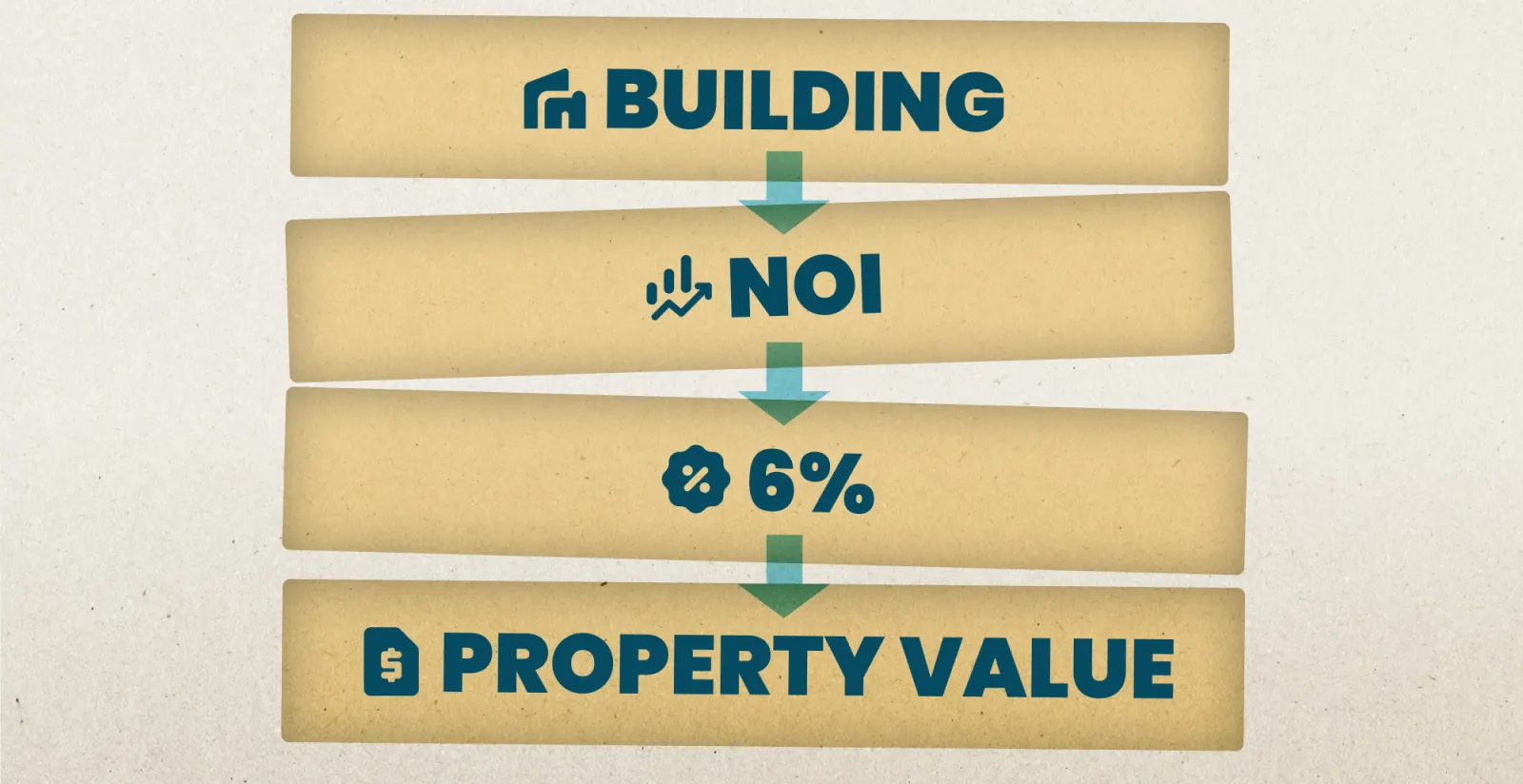
If there's one number that commercial real estate professionals reference more than any other, it's the cap rate. Walk into any conversation about buying, selling, or valuing commercial property and the cap rate will come up within minutes. Brokers use it to price listings. Investors use it to evaluate opportunities. Lenders use it to assess risk. Appraisers use it to determine value.
For beginners entering the world of commercial real estate, understanding cap rates isn't optional—it's foundational. Once you grasp what a cap rate is, what it measures, and how to use it, you'll be able to follow professional conversations, evaluate properties more clearly, and make more informed investment decisions.
This guide explains cap rates from the ground up, using plain language and concrete examples to make the concept practical rather than theoretical.
What a Cap Rate Actually Is
At its simplest, a cap rate is a percentage that expresses the relationship between a property's income and its value.
Think of it this way: if you paid $1 million for a property and it generated $60,000 in income per year, you'd be earning a 6% return on your investment before financing costs. That 6% is essentially what a cap rate captures—the yield a property produces relative to its price.
The formal definition: a cap rate is the ratio of a property's net operating income to its current market value or purchase price, expressed as a percentage.
What makes cap rates powerful is that they work in both directions. Given a property's income and its price, you can calculate the cap rate. Given a property's income and the prevailing cap rate in the market, you can calculate what the property is worth. This two-way utility makes cap rates the universal language of commercial property valuation.
NOI: The Foundation of Every Cap Rate Calculation
Before understanding cap rates fully, you need to understand Net Operating Income, or NOI—because cap rates are built on it.
What NOI Measures
NOI represents what a property actually earns from its operations after paying operating expenses but before making debt payments or paying income taxes.
The calculation is:
Total income from the property
Minus operating expenses
Equals NOI
Operating expenses include property management fees, insurance, property taxes, maintenance, repairs, and utilities paid by the owner. They do not include mortgage payments—debt service is excluded from NOI because the goal is to measure the property's earning power independently of how it's financed.
Illustrative Example: Calculating NOI (For Illustration Purposes Only)
A small retail strip center generates the following annual income:
- Rental income from tenants: $200,000
- Parking fees: $10,000
- Total income: $210,000
The property's annual operating expenses are:
- Property management (8% of rent): $16,000
- Property taxes: $25,000
- Insurance: $8,000
- Maintenance and repairs: $12,000
- Total operating expenses: $61,000
NOI: $210,000 minus $61,000 equals $149,000
That $149,000 is the NOI—the income the property produces from its operations that forms the basis for all cap rate calculations.
The Cap Rate Formula: Step by Step
With NOI established, calculating a cap rate is straightforward.
The formula: Cap Rate = NOI divided by Property Value (or Purchase Price)
The result is expressed as a percentage.
Illustrative Example: Calculating Cap Rate From NOI and Price (For Illustration Purposes Only)
Using the retail strip center from the previous example with an NOI of $149,000:
If the property is listed for sale at $2,483,000:
Cap Rate = $149,000 divided by $2,483,000 = 6%
The cap rate is 6%.
Illustrative Example: Using Cap Rate to Determine Value (For Illustration Purposes Only)
The formula works in reverse too. If you know the NOI and the prevailing cap rate in the market, you can calculate what a property should be worth.
Using the same property:
NOI: $149,000
Market cap rate for similar retail properties: 6%
Property Value = NOI divided by Cap Rate
Property Value = $149,000 divided by 0.06 = $2,483,000
This reverse calculation is how appraisers and investors use market cap rates to value properties. They determine the appropriate cap rate for the market and property type, divide the NOI by that cap rate, and arrive at a value.
Cap Rates as a Measure of Risk
One of the most important things to understand about cap rates is that they function as a measure of risk—not just a return calculation.
Why Lower Cap Rates Mean Lower Risk
Lower cap rates mean investors are accepting lower returns in exchange for investing in properties they consider safer or more stable. These are typically properties in strong locations, with creditworthy tenants on long leases, in well-established markets with deep investor demand.
A 4% cap rate on a prime office building in a major metropolitan area reflects that investors consider this a low-risk investment. They're willing to accept a modest 4% yield because they're confident the income is stable, the property will hold its value, and the exit will be liquid.
Why Higher Cap Rates Mean Higher Risk
Higher cap rates mean investors require higher returns to compensate for taking on more risk. Properties with less certain income, shorter lease terms, weaker tenants, or locations in secondary markets need to offer higher yields to attract buyers.
A 9% cap rate on a commercial property in a smaller market reflects that investors are demanding a higher return because they perceive more uncertainty—about the income's stability, the market's long-term demand, or the property's eventual resale.
The inverse relationship between cap rates and value creates an important dynamic: as cap rates go down, values go up. As cap rates go up, values go down. Understanding this relationship is fundamental to following how commercial real estate markets move.
Illustrative Example: Cap Rate and Risk (For Illustration Purposes Only)
Two properties, each with an NOI of $100,000:
Property A is a grocery-anchored retail center with a long-term lease to a national grocery chain in a growing suburban market. Investors consider this low-risk and price it at a 5% cap rate.
Value: $100,000 divided by 0.05 = $2,000,000
Property B is a multi-tenant strip center in a secondary market with several vacancies and shorter lease terms. Investors consider this higher-risk and price it at an 8% cap rate.
Value: $100,000 divided by 0.08 = $1,250,000
Both properties generate the same NOI, but the risk difference creates a $750,000 difference in value. Cap rate is the mechanism through which the market prices that risk difference.
Typical Cap Rate Ranges by Property Type
While cap rates vary by market, location, and specific property characteristics, general ranges exist by property type that reflect typical risk profiles.
Lower Cap Rate Property Types (Generally Considered Lower Risk)
Industrial and Logistics: Modern industrial facilities, particularly those leased to creditworthy distribution or e-commerce tenants on long-term leases, often trade at lower cap rates reflecting the stability of their income and strong demand.
Multifamily (Apartments): Well-located apartment communities in strong rental markets tend to trade at lower cap rates because housing demand is durable and income relatively stable even through economic cycles.
Net Lease Retail: Properties leased to national credit tenants (think major fast food chains, pharmacies, or dollar stores) on long-term leases where tenants pay most expenses often trade at very low cap rates because the income stream resembles a bond payment.
Moderate Cap Rate Property Types
Office: Office properties have seen significant cap rate evolution as remote work changed demand dynamics. Suburban office properties and those with diverse tenant rosters typically trade at moderate cap rates reflecting uncertainty about long-term demand.
Retail (Anchored Centers):Grocery-anchored and necessity-based retail centers typically trade at moderate cap rates because their anchor tenants drive reliable foot traffic regardless of economic conditions.
Higher Cap Rate Property Types (Generally Considered Higher Risk)
Hospitality: Hotels experience significant income volatility because room rates and occupancy fluctuate with economic conditions and travel patterns. This income uncertainty pushes cap rates higher.
Special Purpose: Properties designed for highly specific uses—car washes, self-storage facilities in secondary markets, or specialized industrial—may trade at higher cap rates reflecting their limited buyer pool and specific operational risks.
It's important to remember that these are general observations. Specific properties within any category can trade above or below typical ranges based on their individual characteristics, location, lease terms, and tenant quality.
How Properties Actually Trade on Cap Rates
Understanding the cap rate formula is one thing. Understanding how cap rates actually function in real transactions helps bring the concept to life.
Sellers Price Properties on Cap Rates
When a commercial property owner decides to sell, the asking price is typically set based on the property's NOI and the prevailing cap rate for similar properties in the market. The seller calculates what their NOI is, researches what cap rates similar properties have traded at recently, and sets a price accordingly.
For illustrative purposes only: if a property generates $200,000 in NOI and similar properties in the market have recently sold at 6% cap rates, the seller would price the property at approximately $3,333,000 ($200,000 divided by 0.06).
Buyers Evaluate Properties on Cap Rates
Buyers approaching a listed property evaluate whether the asking cap rate makes sense relative to comparable transactions, the property's risk profile, and their own return requirements.
A buyer might look at a property priced at a 5.5% cap rate and determine that given the property's characteristics and market conditions, they'd need a 6% cap rate to achieve their investment return targets. This gap creates the starting point for price negotiations.
Cap Rates Create Market Transparency
Because both buyers and sellers use cap rates as their common language, the metric creates transparency in commercial real estate markets. When a broker announces that a property sold at a 5.8% cap rate, experienced investors immediately understand the price relative to income without needing to know the specific numbers.
This shared language also makes it possible to compare properties across different sizes and markets. A $500,000 property and a $50 million property can both be evaluated on the same cap rate basis, making it possible to assess relative value across very different scales.
What Rising and Falling Cap Rates Mean for Investors
Cap rates aren't static—they move with market conditions, interest rates, investor demand, and economic factors. Understanding what these movements mean helps investors navigate changing commercial real estate environments.
When Cap Rates Fall (Values Rise)
Falling cap rates mean investors are accepting lower returns for the same income—which means they're paying more for properties. This typically happens when:
- Investor demand for commercial real estate increases, driving competition for available properties
- Interest rates fall, making real estate income relatively more attractive compared to alternatives
- Economic confidence rises, making investors more comfortable accepting lower risk premiums
For property owners, falling cap rates are beneficial because they increase the value of their holdings. A property generating $200,000 in NOI is worth $3,333,000 at a 6% cap rate but $4,000,000 at a 5% cap rate—the same income is worth significantly more when cap rates compress.
When Cap Rates Rise (Values Fall)
Rising cap rates mean investors are demanding higher returns for the same income—which means they're paying less for properties. This typically happens when:
- Interest rates rise, making debt more expensive and competing investments more attractive
- Economic uncertainty increases, making investors less willing to accept low risk premiums
- Investor demand for commercial real estate decreases
For property owners, rising cap rates reduce the value of their holdings. That same $200,000 NOI property is worth $2,500,000 at an 8% cap rate—significantly less than at lower cap rate environments.
Illustrative Example: Cap Rate Movement Impact (For Illustration Purposes Only)
An investor owns a property generating $150,000 in NOI purchased at a 5.5% cap rate ($2,727,000 purchase price).
If cap rates in the market rise to 7% while the NOI remains constant:
New value: $150,000 divided by 0.07 = $2,142,857
The property has lost approximately $584,000 in value despite no change in its actual income. This illustrates why changes in market cap rates matter to owners even when their properties are performing as expected.
Common Cap Rate Misconceptions for Beginners
Several misunderstandings about cap rates are common among investors just learning commercial real estate fundamentals.
Misconception: A Higher Cap Rate Is Always Better
Beginners sometimes assume that a higher cap rate is automatically better because it means a higher return. But cap rates are risk measures as much as return measures. A higher cap rate often indicates higher risk—a less stable income stream, a weaker market, or property-specific challenges.
Buying a property at a high cap rate can be the right decision if you understand and can manage the associated risks. But buying it simply because the number looks higher than alternatives without understanding what that cap rate is telling you about risk is a mistake.
Misconception: Cap Rate Equals Total Investment Return
The cap rate measures the property's income yield at a specific point in time. It doesn't capture appreciation or depreciation in property value, the impact of financing, changes in NOI over time, or the return generated when the property is sold.
An investor's total return on a commercial property depends on all of these factors together. Cap rate is an important input but not the complete picture.
Misconception: Cap Rates Work the Same Way for All Property Types
As discussed above, cap rates vary significantly by property type, location, and market conditions. Comparing a cap rate on a net lease retail property to a cap rate on a multifamily community without accounting for the different risk profiles of each is an apples-to-oranges comparison.
Always evaluate cap rates within their appropriate context—comparing similar property types in similar markets—rather than treating any cap rate number as universally meaningful.
Cap Rates in Texas Commercial Real Estate
Texas commercial real estate markets reflect the same cap rate dynamics as the broader market, shaped by the state's strong economic fundamentals.
Texas's consistent population growth, diverse economic base, and pro-development regulatory environment have historically supported strong investor demand for commercial properties across the state's major metros. This investor demand generally supports competitive cap rate environments in primary markets like Dallas-Fort Worth, Houston, Austin, and San Antonio.
Growth corridors and secondary markets within Texas often offer higher cap rates than primary urban cores, reflecting the balance between growth potential and the relative newness or less established nature of those markets compared to core urban assets.
For investors evaluating Texas commercial real estate opportunities, understanding how cap rates vary across the state's diverse markets—from established urban assets to growth corridor opportunities—is essential for making appropriate comparisons and investment decisions.
How FISYN's Land Investment Approach Differs
Understanding cap rates fully requires understanding where they apply—and where they don't. FISYN's approach to Texas commercial land investment operates in a fundamentally different framework than cap rate-based investing in income-producing properties.
Land Doesn't Generate NOI During the Holding Period
Cap rates require NOI to function. Income-producing properties—apartments, office buildings, retail centers, industrial facilities—generate rent that can be measured, divided by price, and expressed as a cap rate.
Raw and developing commercial land doesn't generate rental income during the holding period. FISYN acquires land, navigates the entitlement process to enhance its value, and sells to developers. Throughout this process, the land isn't producing rent—it's producing value through strategic enhancement rather than operational income.
This means cap rates don't apply to FISYN's acquisitions the way they apply to income-producing property investments. The return framework is different: value is created through the entitlement process and captured at sale rather than through ongoing income generation measured against a purchase price.
Developer Demand Drives Exit Pricing
When FISYN sells entitled commercial land to developers, those developers evaluate the land's price relative to what they can build on it and what the completed project will be worth. They're thinking about yield on cost and development spread—metrics that account for building a new project rather than buying an existing income stream.
This exit framework connects FISYN's land investment strategy to cap rate thinking in an indirect but important way: the developers who buy FISYN's entitled land will eventually build properties that trade on cap rates. The economics of those future projects—including the cap rate at which they'll be valued when complete—inform what developers are willing to pay for entitled land today.
The Return Profile for Investors
For investors in FISYN's Texas commercial land investment strategy, returns come from a combination of monthly income distributions during the holding period and equity participation when properties sell—not from an ongoing cap rate yield on an income-producing asset.
This different return structure is appropriate for a different type of investment: land development and value creation rather than income property ownership. Understanding this distinction helps investors in Texas commercial land for accredited investors evaluate FISYN's approach on its own terms rather than forcing it into a cap rate framework designed for a different asset category.
The Bottom Line: Cap Rates as Your Commercial Real Estate Compass
Cap rates are the compass of commercial real estate. They orient every conversation about value, risk, and return in income-producing properties. Once you understand what they measure—the relationship between income and price, used as a proxy for risk—you can follow professional conversations, evaluate opportunities, and make more informed investment decisions.
The core principles are simple: cap rates are calculated by dividing NOI by property value. Lower cap rates indicate lower risk and higher values. Higher cap rates indicate higher risk and lower values. Market cap rates move with economic conditions, interest rates, and investor demand, causing property values to rise and fall even when income remains constant.
For investing in Texas commercial real estate across the full range of property types, cap rates provide the common language that makes comparison and evaluation possible. And understanding where cap rates apply—and where different frameworks like FISYN's land investment approach are more appropriate—helps investors navigate the full landscape of commercial real estate opportunity.
Important Disclosure: This article is for educational purposes only and does not constitute financial advice. Past performance does not guarantee future results. All investments carry risk, including the potential loss of principal. Please consult with a qualified financial professional before making investment decisions.