
15 min read
Why Texas Is the Top Real Estate Market for Commercial Land Investment
Written on January 31, 2026 By Ron McVaney
Ready to start investing in Texas real estate?
Book Your Free Call Today
In the world of real estate investing, location determines everything. Choose the wrong market and even the best strategy struggles. Choose the right market and opportunities multiply.
For investors focused on commercial land and development opportunities, one state stands clearly above the rest: Texas.
The Lone Star State has become the undisputed leader in real estate investment opportunities, offering a unique combination of explosive population growth, economic strength, business-friendly policies, and infrastructure investment that creates sustained demand for commercial land.
This comprehensive guide explores why Texas is the top real estate market, examines specific Texas real estate growth markets within the state, and explains how smart investors are capitalizing on this opportunity through strategic commercial land investments.
The Numbers Don't Lie: Texas Economic Dominance
Before diving into specific opportunities, let's examine the fundamental economic strength that makes investing in Texas commercial real estate so compelling.
Texas as a Global Economic Power
If Texas were its own country, it would have the 8th largest GDP in the world, ahead of Canada, South Korea, and Russia. This isn't just a talking point. It's a fundamental indicator of economic strength that drives sustained real estate demand.
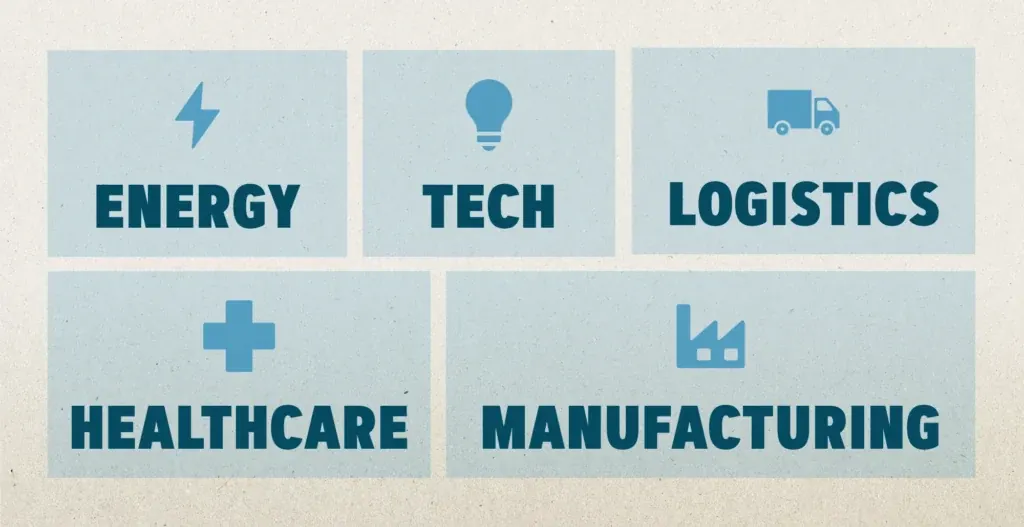
The state's economy exceeds $2 trillion annually, built on a diversified foundation spanning:
- Energy and natural resources
- Technology and innovation
- Healthcare and life sciences
- Manufacturing and aerospace
- Financial services
- Agriculture and logistics
This diversification provides stability that single-industry states can't match. When oil prices decline, technology and healthcare growth offset the impact. When tech markets cool, energy and manufacturing maintain momentum.
Population Growth: The Foundation of Real Estate Demand
Texas has led the nation in population growth for over two decades, adding roughly 4 million residents between 2010 and 2020 alone. Current projections show this trend continuing, with Texas expected to add another 5 to 6 million residents by 2030.
Five of the 15 most populated cities in the United States are in Texas:
- Houston (4th largest)
- San Antonio (7th largest)
- Dallas (9th largest)
- Austin (11th largest)
- Fort Worth (13th largest)
This population influx isn't random. People are moving to Texas deliberately, attracted by job opportunities, affordable housing (relative to coastal markets), no state income tax, and quality of life factors.
More people means sustained demand for housing, commercial space, retail, healthcare facilities, schools, and infrastructure. All of this requires land, creating the foundation for why investing in Texas land makes strategic sense.
Business Migration: The Jobs That Drive Growth
The population follows jobs, and jobs are following businesses to Texas at an unprecedented rate. Major corporations continue relocating headquarters and expanding facilities throughout the state:
- Tesla moved headquarters to Austin
- Oracle moved headquarters to Austin
- Hewlett-Packard Enterprise moved headquarters to Houston
- Charles Schwab moved headquarters to Dallas
- CBRE moved headquarters to Dallas
These aren't just symbolic moves. They bring thousands of high-paying jobs, which attract workers, which drives housing demand, which requires land development.
Beyond headline-grabbing relocations, thousands of smaller companies expand Texas operations annually, creating sustained job growth that supports long-term real estate demand.
Texas vs Other Major Markets: The Competitive Advantage
Understanding why Texas is the top real estate market requires comparing it to other major investment destinations.
Texas vs California
California has long been a real estate powerhouse, but the state increasingly pushes businesses and residents toward Texas:
Cost Structure
California's median home price exceeds $800,000. Texas median home price sits around $300,000. This affordability gap drives both residential and commercial relocation.
Tax Burden
California's top income tax rate hits 13.3%. Texas has no state income tax. For businesses and high earners, this difference is massive and drives relocation decisions.
Regulatory Environment
California's complex regulations, lengthy permitting processes, and high compliance costs create barriers to development. Texas offers a more streamlined, business-friendly approach that accelerates projects and reduces costs.
Business Climate
California ranks near the bottom in business climate surveys. Texas consistently ranks near the top. This perception shapes corporate location decisions and drives the business migration that creates real estate demand.
The result? More people and businesses leave California for Texas than any other state-to-state migration pattern in the country.
Texas vs Florida
Florida offers similar advantages (no state income tax, pro-business policies, strong growth) and competes with Texas for relocating businesses and residents.
Economic Diversification
Texas's economy is significantly more diversified than Florida's, which relies heavily on tourism, real estate, and retirees. Texas's diverse economic base provides more stability across different economic conditions.
Scale and Growth Potential
Texas is larger with more major metropolitan areas offering investment opportunities. While Miami and Tampa are strong markets, Texas offers Houston, Dallas, Fort Worth, Austin, San Antonio, and numerous secondary markets.
Land Availability
Texas's vast geography provides more opportunities for large-scale land development projects that Florida's more constrained geography limits.
Texas vs New York
The Texas-New York comparison highlights why businesses choose Texas:
Cost of Doing Business
Operating costs in New York, particularly New York City, are among the highest in the nation. Texas offers dramatically lower costs for office space, industrial facilities, and cost of living for employees.
Taxation
New York's high state and local taxes (including income tax up to 10.9%) contrast sharply with Texas's zero income tax. This difference saves businesses and employees substantial money annually.
Regulatory Flexibility
New York's complex regulatory environment and union presence create challenges for businesses. Texas's lighter regulatory touch and right-to-work status provide more operational flexibility.
Weather and Quality of Life
While subjective, Texas's warmer climate and lower cost of living attract workers who might otherwise stay in New York, facilitating corporate relocations.
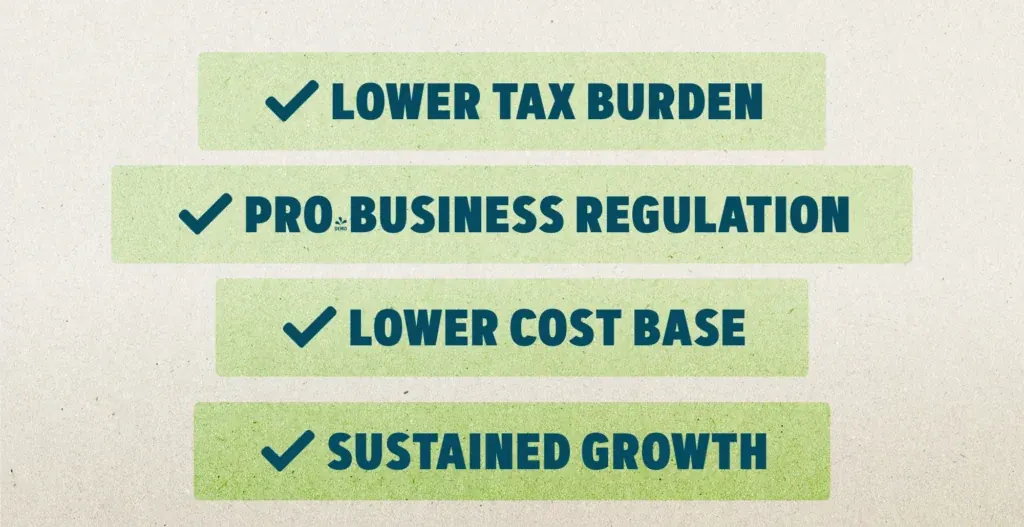
These comparisons explain why Texas consistently wins corporate relocation and expansion decisions, driving the sustained demand that makes Texas real estate market high growth so compelling for investors.
Texas Real Estate Tax Benefits: The Investor Advantage
Beyond growth fundamentals, Texas offers specific tax advantages that enhance investment returns.
No State Income Tax
Texas is one of only a few states with no personal income tax. This impacts real estate investors in several ways:
Higher Net Returns
Investment income isn't subject to state income taxation, meaning more of your gains stay in your pocket. In California or New York, you'd pay an additional 10% to 13% on investment profits to state governments.
Attracts High-Income Residents
The lack of income tax attracts high earners who become potential buyers or tenants for developed properties, supporting premium pricing and strong demand.
Business Attraction
No corporate income tax (Texas uses a gross receipts tax at lower effective rates) continues attracting businesses that drive real estate demand.
Property Tax Structure
Texas property taxes are higher than some states, funding local services without income tax revenue. However, several factors make this manageable for investors:
Deductibility
Property taxes are deductible for investment properties, reducing the federal tax burden.
Homestead Exemptions
Primary residence owners receive exemptions that don't apply to investment properties, but the overall tax base spreads across many property owners, preventing excessive concentration.
Value-Based Assessment
Property taxes follow property values. In appreciating markets, this means taxes rise with asset values, but investors benefit from appreciation that more than offsets increased taxes.
Predictable and Transparent
Texas property taxes are straightforward and predictable, unlike complex tax structures in some states that create uncertainty.
1031 Exchange Opportunities
Texas's strong market provides excellent opportunities for 1031 exchanges, allowing investors to defer capital gains taxes by reinvesting proceeds into new Texas properties. The state's diverse markets offer numerous exchange options within a single state.
Opportunity Zones
Texas has designated Opportunity Zones in areas poised for growth, offering tax incentives for investments including deferral and potential elimination of capital gains taxes on appreciation in qualified investments.
Texas Real Estate Growth Markets: Where the Opportunities Are
While Texas overall offers strong opportunities, specific markets within the state present particularly compelling investment cases.
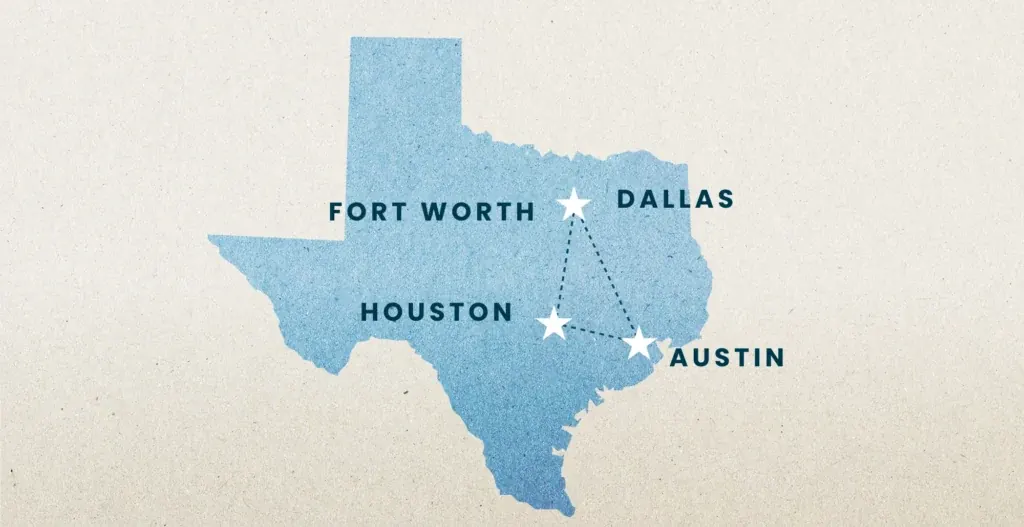
Dallas-Fort Worth Metroplex
The DFW metroplex is the largest metro area in Texas and 4th largest in the United States, with over 7.6 million residents and growing.
Dallas: The Corporate Hub
Dallas serves as a major corporate headquarters location, with particular strength in financial services, technology, telecommunications, and professional services. The city's central location, excellent airport connectivity, and business infrastructure attract Fortune 500 companies.
For commercial land investors, Dallas offers opportunities in:
- Corporate campus developments in northern suburbs
- Mixed-use developments serving growing residential areas
- Industrial and logistics facilities serving regional distribution
- Healthcare and medical office developments
Fort Worth: The Growth Engine
Fort Worth has emerged from Dallas's shadow to become a growth powerhouse in its own right, with major employers in aerospace (Lockheed Martin), defense, and manufacturing.
The Fort Worth market offers:
- Lower land costs than Dallas while maintaining strong demand
- Significant westward expansion creating development opportunities
- Strong transportation infrastructure including major highways and freight rail
- Pro-development city policies streamlining approval processes
Fort Worth particularly excels for commercial land investment because the city actively encourages growth and development, making rezoning and entitlement processes more efficient than many Texas markets.
Mid-Cities and Growth Corridors
The area between Dallas and Fort Worth, plus corridors extending north, south, and west, offers exceptional opportunities. These areas combine:
- Lower acquisition costs than urban cores
- Path-of-growth positioning as metros expand outward
- Infrastructure investment supporting development
- Strong demand from developers seeking entitled land
Austin: The Technology Boom
Austin has transformed from a quirky college town into a global technology hub, earning the nickname "Silicon Hills."
Economic Drivers
- Tesla Gigafactory employing thousands
- Apple's major campus expansion
- Google, Amazon, and Facebook significant presence
- Oracle headquarters relocation
- Hundreds of smaller tech companies and startups
Growth Characteristics
Austin's population grew faster than any major U.S. city in recent years, creating enormous pressure on housing and commercial space. This rapid growth creates challenges (traffic, housing affordability) but exceptional opportunities for commercial land investors who can provide development-ready sites.
Investment Opportunities
- Residential development sites in growth corridors
- Commercial land for offices, retail, and mixed-use
- Industrial land for manufacturing and logistics
- Land near the expanding Tesla facility and supplier ecosystem
Austin land prices have appreciated dramatically but still offer strong returns through strategic value enhancement and proper timing.
Houston: The Energy and Healthcare Powerhouse
Houston is the 4th largest U.S. city and the economic engine of the Gulf Coast, with the nation's largest medical center and continued energy sector dominance.
Economic Diversity
While known for energy, Houston has successfully diversified into:
- Healthcare (Texas Medical Center is the world's largest)
- International trade (Port of Houston)
- Aerospace (NASA Johnson Space Center)
- Manufacturing and petrochemicals
- Professional services
Growth Patterns
Houston sprawls outward in all directions with relatively few geographic constraints, creating numerous growth corridors and commercial land opportunities. The city's lack of zoning creates unique dynamics but also opportunities for investors who understand local development patterns.
Investment Focus
- Industrial land near the port and petrochemical complex
- Medical office and healthcare facility sites near the Medical Center
- Residential land in master-planned community corridors
- Commercial sites along major highway corridors
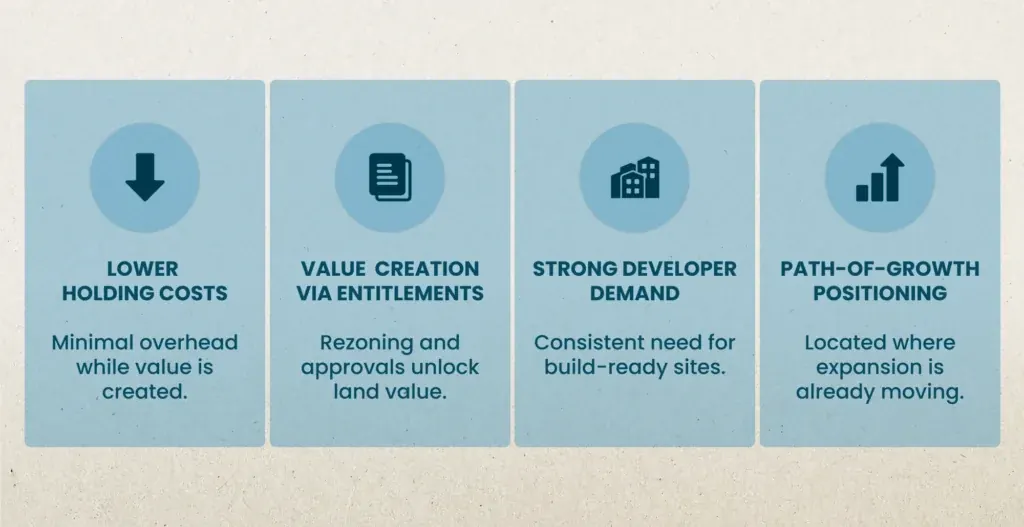
Why Commercial Land Investment Specifically
Understanding why Texas is strong is one thing. Understanding why Texas commercial land investment specifically offers superior opportunities is another.
Lower Holding Costs
Unlike rental properties requiring maintenance, property management, and tenant relations, land sits with minimal ongoing costs:
- No building maintenance or repairs
- No tenant management or turnover
- No property management fees
- Lower insurance costs
- Minimal operational oversight required
This dramatically improves net returns compared to income-producing properties.
Value Enhancement Potential
The real advantage of commercial land investment is the ability to create value through entitlement work rather than waiting for market appreciation:
Rezoning
Converting land from agricultural to commercial or residential use can double or triple its value, creating returns independent of market conditions.
Entitlement
Securing development approvals, permits, and utility connections transforms raw land into shovel-ready development sites commanding premium pricing.
Strategic Positioning
Identifying land in the path of growth before development reaches it allows investors to benefit from inevitable expansion at wholesale prices.
Developer Demand
Texas's sustained growth creates constant developer demand for entitled, development-ready land. Developers pay premiums for land that's ready for immediate construction because:
- Time savings accelerate project completion and returns
- Risk reduction with approvals already secured
- Capital efficiency allowing immediate construction deployment
- Competitive advantage in fast-moving markets
This demand creates reliable exit strategies for commercial land investors who properly position and prepare properties.
Real Results: Texas Commercial Land Investment Returns
The opportunity isn't theoretical. Recent transactions demonstrate the returns possible through strategic Texas commercial land investment:
Austin Area: 45+ Acre Tract
Hold period: 368 days
Return: 350% of purchase price
Strategy: Acquired agricultural land near expanding development, secured commercial zoning and entitlements, sold to residential developer
New Braunfels: 8+ Acre Tract
Hold period: 605 days
Return: 317.78% of purchase price
Strategy: Positioned property in high-growth corridor between San Antonio and Austin, obtained necessary approvals, sold for immediate development
Austin Area: Multiple 2.5-Acre Sites
Return: 225.31% of purchase price
Strategy: Strategic small-lot development play in desirable location with strong demand
These aren't cherry-picked best cases. They represent typical outcomes from well-executed commercial land investment strategies in Texas growth markets.
Texas Real Estate Strategy FISYN: Capitalizing on Market Advantages
Understanding Texas advantages is valuable. Effectively capitalizing on them requires expertise, execution, and a proven strategy.
FISYN's Texas-Focused Approach
FISYN specializes exclusively in Texas commercial land investment, focusing resources and expertise on the markets and property types offering the best risk-adjusted returns.
The strategy combines several key elements:
1. Strategic Market Selection
Not all Texas markets are equal. FISYN focuses on specific high-growth corridors where fundamentals support sustained appreciation, particularly Fort Worth and surrounding areas where:
- Population growth exceeds state averages
- Business relocations drive job creation
- Infrastructure investment supports expansion
- Pro-development policies facilitate projects
- Land availability allows strategic positioning
2. Disciplined Acquisition
Every acquisition must meet strict criteria:
- Clear path to value enhancement through rezoning or entitlement
- Confirmed developer demand in the area
- Conservative pricing providing downside protection
- Strategic positioning in growth corridors
- Clean title and manageable environmental profile
3. Active Value Creation
FISYN doesn't buy land and hope for appreciation. The strategy actively creates value through:
- Securing commercial zoning for agricultural or lower-use land
- Obtaining development entitlements and permits
- Coordinating utility connections and infrastructure
- Preparing sites for immediate development
- Transforming raw land into premium, shovel-ready development sites
4. Pre-Arranged Exit Strategy
Before acquiring properties, FISYN identifies potential buyers and confirms market demand. This forward planning:
- Reduces holding period risk
- Improves exit timing
- Ensures liquidity when properties are ready
- Validates acquisition decisions before committing capital
5. Debt-Free Structure
All acquisitions occur with cash, eliminating:
- Refinancing risk
- Interest rate exposure
- Forced sale pressure
- Financial covenant concerns
- Lender approval requirements
Why This Strategy Works in Texas
FISYN's approach capitalizes specifically on Texas advantages:
Sustained Growth Provides Demand
Consistent population and business growth ensures developers need land, creating reliable exit opportunities.
Pro-Development Policies
Texas's business-friendly environment makes rezoning and entitlement more achievable than in heavily regulated states.
Economic Diversity
Diversified economy means demand persists across different economic conditions, reducing market timing risk.
Scale and Geography
Texas's size provides numerous markets and corridors, allowing geographic diversification within a single state where FISYN maintains deep expertise.
Infrastructure Investment
Ongoing infrastructure development by state and local governments supports growth in targeted corridors, validating investment theses.
Investor Benefits
This Texas-focused strategy delivers specific advantages:
Passive Participation
Investors benefit from Texas opportunities without becoming developers or managing projects. FISYN handles all acquisition, entitlement, and sale activities.
Professional Execution
Decades of Texas real estate experience navigating local markets, regulatory environments, and developer relationships translates into superior execution.
Targeted Returns
The strategy targets 10% to 12% annual distributions plus 20% equity participation in profits when properties sell, combining income and appreciation.
Real Asset Backing
Investments are backed by actual Texas land in high-growth markets, providing tangible value and downside protection.
Proven Performance
Ten consecutive years of double-digit returns demonstrate consistent execution of the strategy across different market conditions.
The Future of Texas Real Estate
Every market eventually matures, but several factors suggest Texas's real estate strength has years or decades to run:
Demographic Trends
Population projections show continued growth well into the 2030s and beyond. Millennials and Gen Z increasingly choose Texas for affordability and opportunity.
Climate Migration
As coastal areas face climate challenges, inland markets like Texas attract climate refugees seeking stability.
Remote Work Evolution
Remote work flexibility allows workers to choose locations based on cost of living and quality of life, benefiting Texas over expensive coastal markets.
Continued Business Migration
Tax and regulatory advantages that attract businesses to Texas aren't changing. If anything, the gap between Texas and high-tax states is widening.
Infrastructure Investment
Texas continues investing in transportation, utilities, and infrastructure supporting sustained growth.
These long-term trends suggest the opportunity window remains wide open for investors who act strategically.
Getting Started with Texas Commercial Land Investment
For investors convinced by Texas's advantages but uncertain how to access opportunities, several paths exist:
Direct Investment
Purchase land directly, manage entitlement yourself, and find buyers. This requires expertise, time, capital, and risk tolerance most investors don't have.
Partner with Developers
Joint venture with developers on specific projects. This provides access but requires substantial capital and active involvement.
Invest with Experienced Operators
Partner with firms like FISYN that specialize in Texas commercial land investment, providing professional management and proven execution without requiring active involvement or developer-level expertise.
For most investors, this third path offers the best combination of access, professional management, and risk-adjusted returns.
The Bottom Line: Texas Opportunity Meets Strategic Execution
Texas is unquestionably the top real estate market for commercial land investment. The combination of explosive population growth, economic strength, business migration, tax advantages, and infrastructure investment creates sustained demand that supports exceptional returns.
But market strength alone doesn't guarantee success. Execution matters. Understanding which specific markets offer the best opportunities, how to identify and acquire strategic properties, how to navigate rezoning and entitlement processes, and how to efficiently exit at optimal timing separates successful investors from those who struggle.
FISYN's decade of proven performance in Texas commercial land investment demonstrates that combining market advantages with professional execution delivers consistent results. The strategy of acquiring strategically located land, actively enhancing its value through entitlement work, and selling to developers at multiples of purchase price has generated double-digit returns across different market conditions.
For investors seeking to capitalize on Texas's continued growth through passive participation in commercial land investment, understanding why Texas is the top real estate market is the first step. The second step is connecting with experienced operators who can translate market advantages into actual returns.
The Texas opportunity is real, substantial, and continuing. The question isn't whether Texas will remain strong, it's whether you'll position yourself to benefit from that strength through strategic commercial land investment.
Important Disclosure: This article is for educational purposes only and does not constitute financial advice. Past performance does not guarantee future results. All investments carry risk, including the potential loss of principal. Real estate investments are typically illiquid and may not be suitable for all investors. Please consult with a qualified financial professional before making investment decisions.