
13 min read
Population Migration Trends Shaping Texas Real Estate
Written on June 23, 2026 By Ron McVaney
Ready to start investing in Texas real estate?
Book Your Free Call Today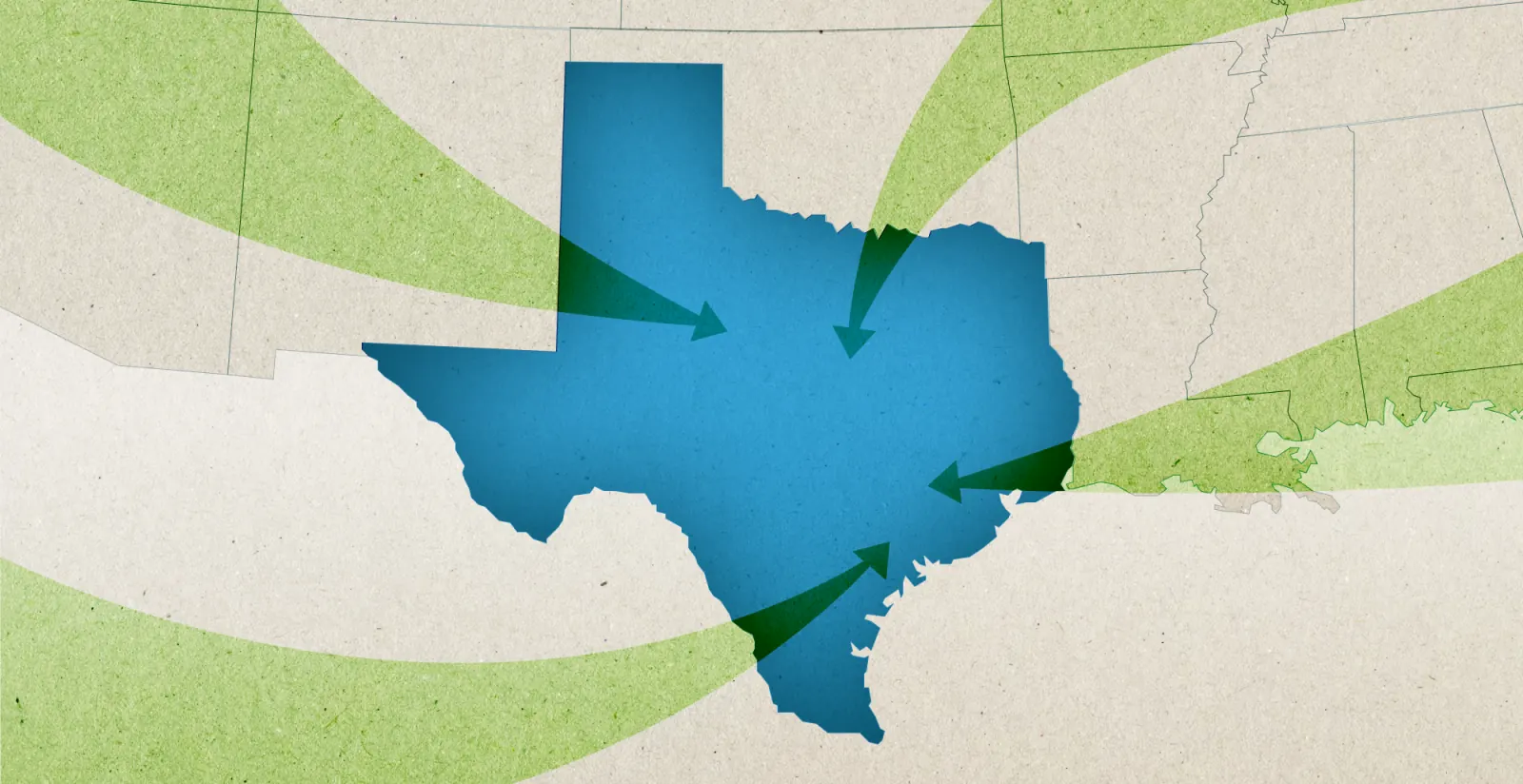
Texas continues to attract more new residents than any other state in the nation, but the migration story has changed significantly from the pandemic-era boom. Understanding current migration patterns—where people are coming from, why they're moving, and how Texans are relocating within the state—provides essential context for real estate investors trying to separate sustainable opportunity from post-pandemic noise.
The headline numbers remain impressive. Texas added approximately 391,000 residents in 2025, bringing the total population to roughly 31.7 million, according to data reported by the Texas Tribune. [1] Yet beneath those numbers, migration inflows have slowed sharply, and that deceleration is reshaping real estate dynamics across every major market in the state.
This article examines current migration patterns driving Texas real estate, what those patterns mean for different property types, and where investors focused on commercial land development should be paying attention.
The Current Migration Picture: Strong But Slowing
Texas remains the top destination for domestic migrants in the United States, but the pace of arrivals has moderated considerably from pandemic peaks.
Net Domestic Migration
Between July 2023 and July 2024, Texas recorded the largest net domestic migration in the country at approximately +85,000 people, according to data from ResiClub Analytics. [2] That sounds strong until you compare it to the pandemic peak of around +222,000 net domestic migrants. By the year ending June 2025, net domestic migration had fallen further to approximately 67,000, down from nearly 219,000 just three years earlier—the lowest level in about two decades, according to the Texas Tribune. [1]
Importantly, the slowdown reflects fewer new arrivals rather than a surge in departures. People aren't leaving Texas in unusual numbers. Fewer people are choosing to come, a meaningful distinction for evaluating long-term market fundamentals.
International Migration
International migration has also declined sharply. Texas received roughly 167,000 newcomers from abroad in 2025, approximately 48 percent fewer than the year before, according to reporting from Marketplace. [3] Stricter federal immigration policies are cited as a primary driver of this decline.
This drop in international migration has created uneven effects across Texas markets, with some Houston neighborhoods experiencing rising rental vacancy rates as the foreign-born population declined in specific submarkets.
Total Movement Within and Into Texas
Despite the slowdown in net figures, the absolute volume of movement involving Texas remains enormous. A separate study cited by Fox 26 Houston estimated roughly 265,000 adults moved into Texas from out of state in the most recent year. [4] Within the state, approximately 1.6 million adults moved to or within Texas, and about 84 percent of all moves involved people relocating inside Texas rather than arriving from elsewhere. [4]
That 84 percent figure is critical for understanding real estate dynamics. The Texas real estate market isn't driven solely by outsiders arriving. It's shaped primarily by Texans themselves moving between cities, suburbs, and regions within the state.
Where People Are Coming From
Understanding which states are sending residents to Texas helps explain the demographic and economic profile of new arrivals.
Primary Source States
According to data reported by Fox 26 Houston, the largest shares of out-of-state arrivals come from California, Florida, and Colorado, followed by Arizona, Illinois, and Louisiana. [4]
Each source state tells a different story about why people are leaving:
California remains the largest single source of Texas migrants. High housing costs, elevated state income taxes (up to 13.3%), complex regulations, and cost-of-living pressures continue pushing both businesses and individuals toward Texas. California migrants tend to bring higher incomes and equity from home sales, enabling purchases at price points above typical local buyers.
Florida migrants represent a different profile. Florida has grown rapidly itself and sends migrants to Texas often seeking job opportunities, lower home prices in specific markets, or proximity to family and professional networks.
Colorado, Arizona, and Illinois migrants reflect varied motivations including housing affordability, job relocation, and lifestyle preferences. Illinois in particular sends migrants to Texas's major metros as Chicago's economic and tax environment pushes residents toward lower-cost, lower-tax alternatives.
Louisiana migration into Texas reflects proximity and longstanding economic connections, with Houston serving as a natural destination for Louisiana residents seeking expanded job markets.
Texas as Both Importer and Exporter
An important nuance in Texas migration data is that Texas has itself become a significant source of out-migrants to other states. According to the Texas Tribune, Texas supplied more new residents than any other state to places including Colorado, New Mexico, Oklahoma, and California, even while its own population continued growing. [5]
This bidirectional flow suggests a more dynamic migration pattern than simple "people are moving to Texas" narratives capture. Texas is part of a complex network of domestic migration flows rather than a pure one-way destination.
Within-Texas Migration: The Internal Story
With 84 percent of Texas moves involving people relocating inside the state rather than arriving from elsewhere, internal migration patterns deserve careful attention.
Major Metro Attractors
The Dallas-Fort Worth-Arlington metropolitan area recorded over 500,000 movers in a single year, the largest internal migration draw in the state, according to data cited in the Perplexity research report. [4] The Houston area followed with approximately 376,000 movers, with Austin and San Antonio also registering strong internal migration volumes.
These figures reflect both people arriving in these metros from smaller Texas cities and towns, and residents moving within metro areas themselves from urban cores to suburban and exurban communities.
Suburban and Exurban Expansion
Fast-growing metros like Dallas-Fort Worth and San Antonio continue seeing strong demand in suburban and exurban areas along highway corridors, driven by job growth and in-state movers seeking more space at lower prices than urban cores offer, according to the Dallas Federal Reserve research cited in the report. [6]
This suburban expansion is particularly significant for commercial land investment because it creates the development pressure that turns agricultural and underdeveloped land into entitled commercial properties. As residential development spreads along these corridors, demand for supporting commercial, retail, and industrial land follows closely behind.
Austin's Internal Adjustment
Austin presents a more complex internal migration story. The city experienced some of the most dramatic price increases during the pandemic as migration surged, then saw significant cooling as inward migration slowed. According to the research report, Austin has had to adjust as inward migration cooled, leaving developers and sellers more reliant on local buyers and causing some softening in prices and longer listing times relative to peak conditions. [2]
This adjustment doesn't mean Austin is struggling—it means the market is normalizing from extraordinary pandemic-era conditions to more sustainable, income-driven demand patterns.
How Migration Patterns Affect Residential Real Estate
Migration patterns create direct and measurable effects on residential real estate across Texas markets.
Demand Moderation After Pandemic Surge
Population growth and migration still support housing demand, but the cooling of inflows has eased some of the extreme price pressures that built up during the pandemic, according to the research report. [2] Markets that experienced rapid price appreciation driven by migration are adjusting toward more normal, income-driven dynamics.
This moderation benefits long-term market health. Prices driven by sustainable income growth are more durable than prices driven by migration surges that can decelerate as quickly as they accelerated.
Builder Response to Slowing Migration
During the pandemic surge, builders ramped up new construction aggressively to meet demand. As migration slowed and borrowing costs increased, builders in some markets have had to offer more incentives or price adjustments, according to the research report. [7] This competition between new and existing homes is reshaping buyer dynamics in certain submarkets.
Rental Market Divergence
The rental market shows diverging trends based on migration composition. In Dallas-Fort Worth and San Antonio, strong domestic in-migration and job growth support rental demand. In parts of Houston, landlords have reported higher vacancy rates and weaker demand in immigrant-heavy neighborhoods as some residents departed due to concerns tied to immigration enforcement and a broader decline in the foreign-born population, according to the research report. [4]
This divergence underscores the importance of submarket-level analysis rather than relying on statewide trends when evaluating rental real estate investments.
How Migration Patterns Affect Commercial Real Estate
Commercial real estate responds to migration patterns differently than residential, with some sectors benefiting directly while others reflect longer-term demand cycles.
Retail and Consumer Services
In-migration brings consumer spending. Each new Texas resident represents sustained demand for groceries, restaurants, services, healthcare, and retail. While the pace of arrivals has slowed, cumulative population gains over recent years continue supporting retail expansion in growing corridors.
Markets where domestic in-migration remains strong—particularly DFW and San Antonio—continue attracting retail development. Markets where migration has cooled more dramatically, like certain Austin submarkets, face more competitive retail environments requiring stronger tenant fundamentals to support new development.
Office and Employment Centers
Corporate relocations and business expansions that follow migration into Texas create office and employment center demand. The most migration-rich corridors attract supporting professional services, healthcare providers, and business service companies requiring commercial space.
DFW in particular benefits from its status as a corporate relocation destination, creating office park and business campus development demand that persists through migration slowdowns as relocated companies continue expanding operations.
Industrial and Logistics
Texas's population growth, regardless of whether it comes from migration or natural increase, creates sustained consumer demand that requires distribution and fulfillment infrastructure. Industrial real estate demand in Texas is driven as much by e-commerce consumption patterns as by migration specifically.
The Port of Houston and major highway corridors continue attracting industrial development tied to Texas's role as a regional and national distribution hub. This demand is less sensitive to migration fluctuations than residential or retail.
How Migration Patterns Affect Land Investment Specifically
For land investors, migration patterns create specific opportunities and risks worth examining carefully.
Development-Ready Land Demand Remains Strong
Despite migration slowdown, the absolute volume of population movement within and into Texas—391,000 net new residents annually plus 1.6 million internal moves—continues requiring new housing, commercial facilities, and supporting infrastructure. All of this requires Texas real estate development ready land.
Developers need entitled, development-ready land to execute projects serving this demand. The sustained need for new construction across major Texas metros maintains developer appetite for well-positioned commercial land in growth corridors.
Path of Growth Positioning Matters More Than Ever
During the pandemic boom, almost any Texas land appreciated as demand overwhelmed supply. The current more selective environment rewards land positioned in specific growth corridors with demonstrated development activity rather than speculative positions distant from current growth.
Research presented to the Federal Reserve Bank of Dallas indicates that migration-driven demand shocks do not map uniformly onto price cycles—some areas with strong migration see moderate price growth if supply keeps up, while others with constrained land or regulatory limits see sharper price movements. [6]
This nuance means successful Texas land investment requires submarket-level analysis rather than broad-market Texas assumptions.
Suburban Corridor Land Advantages
The persistent suburban and exurban expansion documented in migration data creates particular opportunity for land investors in highway corridors extending from major metros. As residential development spreads outward, demand for commercial land supporting those communities follows predictably.
Fort Worth's westward expansion, San Antonio's northern and western growth, and DFW's surrounding suburban corridors represent paths of growth where development-ready land finds ready buyers among residential and commercial developers.
Internal Migration Creates Sustained Churn
The 84 percent internal migration figure—Texans moving within Texas—represents a sustained source of real estate demand independent of out-of-state arrivals. Texans moving from smaller cities to major metros, from urban cores to suburbs, or between metros create housing transactions and commercial development needs that persist regardless of external migration fluctuations.
This internal demand provides a floor under Texas real estate markets that states dependent primarily on external migration cannot match.
Texas Real Estate Investment Risks and Benefits in the Migration Context
Understanding current migration trends requires honestly assessing both opportunities and risks for real estate investors.
Benefits for Investors
Sustained absolute growth: Even at slowed rates, Texas adds more residents annually than any other state. The absolute demand created by 391,000 new residents plus 1.6 million internal movers is enormous.
Internal migration resilience: The 84 percent internal migration share means Texas demand is less dependent on external factors than migration headlines suggest.
Selective opportunity: Migration slowdown has separated strong fundamentals from pandemic speculation, creating clearer signals about which markets and corridors offer sustainable investment opportunity.
Corporate relocation pipeline: Business relocations to Texas continue creating employment-driven migration that sustains demand in DFW and Houston regardless of broader migration trends.
Risks for Investors
Submarket divergence: Statewide statistics mask significant variation. Houston rental markets in immigrant-heavy areas face vacancy pressures while other Houston submarkets remain tight. Austin faces supply-demand rebalancing after pandemic overbuilding. Investors relying on statewide trends without submarket analysis face mismatch risk.
Policy sensitivity: International migration's 48 percent decline demonstrates how sensitive some Texas markets are to federal immigration policy changes. Areas dependent on international arrivals for housing demand face ongoing policy risk.
Construction competition: Builders who ramped up aggressively during the pandemic are competing for a smaller pool of buyers and renters in some markets, creating price pressure on existing properties and land valuations.
Income-constrained demand: As markets shift from migration-driven to income-driven demand, projects must underwrite based on what local incomes can support rather than assuming migration premiums will sustain high prices.
FISYN's Strategy in the Context of Migration Trends
Understanding how migration patterns interact with Texas real estate strategy FISYN helps investors evaluate whether FISYN's land-focused approach aligns with current market conditions.
Why Migration Slowdown Doesn't Undermine the Strategy
FISYN's approach focuses on acquiring undervalued commercial land in strategic Texas growth corridors, enhancing value through rezoning and entitlement, and selling to developers serving ongoing development demand. This strategy doesn't require pandemic-level migration to succeed.
Even at current moderated migration levels, Texas adds more residents than any other state while 1.6 million Texans move internally each year. This sustained activity requires ongoing new construction across residential, commercial, and industrial sectors—all of which demand entitled land.
Submarket Focus Aligns With Current Conditions
The research report notes that current conditions call for more granular, submarket-level analysis rather than assuming that Texas growth alone guarantees appreciation. [7] This observation aligns directly with FISYN's approach of focusing on specific high-growth corridors within Texas rather than making broad-market bets.
By targeting markets where development activity is current and developer demand is confirmed rather than speculative, FISYN's strategy is positioned for current conditions rather than requiring a return to pandemic-era migration levels.
Texas Land-Backed Real Estate Investment Fundamentals Remain Intact
The fundamental case for Texas land-backed real estate investment rests on sustained development demand rather than migration headlines. Developers need entitled land in strategic locations to execute projects serving the persistent demand created by Texas's continued growth—whether that growth comes from California migrants, Louisiana residents, or Texans moving from Lubbock to Fort Worth.
FISYN's debt-free acquisition structure also provides resilience in current conditions. Without debt service obligations, properties can be held through slower periods without forced sale pressure, allowing optimal exit timing as development cycles align.
The Bottom Line: Migration Patterns Point to Selective Opportunity
Texas migration trends tell a nuanced story that sophisticated real estate investors should understand fully. Net migration has slowed significantly from pandemic peaks. International immigration has declined sharply. Certain submarkets face real headwinds from these trends.
Yet Texas still adds more residents than any state, with 391,000 in 2025. It still records the largest net domestic migration in the country. Its internal migration of 1.6 million annual movers creates demand largely independent of external flows. Corporate relocations continue driving employment-based migration into DFW and Houston.
The current environment rewards investors who understand these nuances—who analyze submarkets rather than statewide trends, who focus on development-ready land in corridors with current activity rather than speculative positions awaiting future migration, and who have the financial structure to hold through slower periods without forced liquidation.
For Texas real estate growth potential land investors, the migration slowdown has clarified the market rather than undermined it. The speculative excess of the pandemic era has largely cleared, leaving behind sustainable demand driven by real economic fundamentals—exactly the conditions that support disciplined, long-term land investment strategies.
Sources
[1] Texas Tribune, "Texas population 2025 census," January 27, 2026. https://www.texastribune.org/2026/01/27/texas-population-2025-census/
[2] ResiClub Analytics, "Net domestic migration: which states are gaining and losing Americans." https://www.resiclubanalytics.com/p/net-domestic-migration-which-states-are-gaining-and-losing-americans
[3] Marketplace, "How a decline in immigration impacts housing demand," October 6, 2025. https://www.marketplace.org/story/2025/10/06/how-a-decline-in-immigration-impacts-housing-demand
[4] Fox 26 Houston, "Texas immigration report 2025." https://www.fox26houston.com/news/texas-immigration-report-2025
[5] Texas Tribune, "Texas out-migration census," January 22, 2026. https://www.texastribune.org/2026/01/22/texas-out-migration-census/
[6] Federal Reserve Bank of Dallas, "Real estate research: migration and housing demand." https://www.dallasfed.org/~/media/Documents/research/events/2022/22realestate-miller.pdf
[7] New York Times, "Texas population growth migration census," January 30, 2026. https://www.nytimes.com/2026/01/30/us/texas-population-growth-migration-census.html
Important Disclosure: This article is for educational purposes only and does not constitute financial advice. Past performance does not guarantee future results. All investments carry risk, including the potential loss of principal. Please consult with a qualified financial professional before making investment decisions.