
14 min read
The Psychology of Investing: How to Stay Calm and Make Better Decisions
Written on December 23, 2025 By Ron McVaney
Ready to start investing in Texas real estate?
Book Your Free Call Today
The numbers don't lie. Studies consistently show that the average investor significantly underperforms the market, not because they pick bad investments, but because they make emotional decisions at exactly the wrong times.
They sell during crashes when fear peaks. They buy during bubbles when greed takes over. They abandon solid strategies after short-term underperformance. They let fear and greed in investing override logic and planning.
Understanding the psychology of investing and how psychology impacts investment decisions is perhaps more important than understanding stocks, bonds, or any specific investment vehicle. Because even the best investment strategy fails if you can't stick with it during inevitable market turbulence.
This guide explores the psychological traps that derail investors, particularly those in or approaching retirement who have the most to lose from emotional mistakes, and provides practical strategies for overcoming fear in investing and building the mental framework that separates successful investors from those who struggle.
Why Psychology Matters More Than You Think
Consider this startling statistic: According to DALBAR's Quantitative Analysis of Investor Behavior, the average equity investor earned just 3.7% annually over the 20-year period ending in 2022, while the S&P 500 returned 9.5% annually during the same period.
That's a massive performance gap, and it's not because investors chose bad funds or lacked information. It's because they let emotions drive their decisions.
They panicked and sold during the 2008 financial crisis, locking in losses. They stayed on the sidelines during the recovery, missing gains. They chased hot stocks in 2021, buying at peaks. They sold during the 2022 downturn, repeating the cycle.
This pattern repeats across every market cycle. The investments are fine. Investor behavior is the problem.

Fear and Greed: The Two Forces That Destroy Returns
Warren Buffett famously said, "Be fearful when others are greedy, and greedy when others are fearful." This sounds simple but proves incredibly difficult to execute because fear and greed are powerful, primal emotions that override rational thinking.
How Fear Drives Bad Decisions
Fear manifests in several destructive ways:
Selling at the Bottom
When markets crash, fear convinces us that this time is different, that the decline will continue forever, that we need to "get out before it gets worse." This panic selling locks in losses at exactly the worst time.
During the March 2020 COVID crash, when the S&P 500 dropped 34% in just 23 days, millions of investors sold in panic. Those who sold missed the subsequent recovery that saw the market reach new highs within months.
An investor who sold a $500,000 portfolio at the bottom in March 2020 and stayed in cash would have missed gains of over $400,000 by the end of 2021. Fear cost them nearly half a million dollars.
Paralysis and Missed Opportunities
Fear also manifests as paralysis, keeping investors on the sidelines long after danger has passed. After the 2008 financial crisis, many investors remained in cash for years, missing the longest bull market in history because they were too scared to reinvest.
This fear-driven paralysis costs compounding returns that can never be recovered.
Over-Reaction to Short-Term Volatility
Fear makes us hyper-focused on short-term movements while ignoring long-term fundamentals. A 5% daily decline feels catastrophic in the moment but means little over a 20-year investment horizon. Yet fear convinces us to react to noise rather than signal.
How Greed Drives Bad Decisions
While fear dominates during downturns, greed takes over during bull markets:
Chasing Performance
When certain investments surge, greed drives us to chase returns. We see neighbors getting rich on cryptocurrency or tech stocks and feel we're missing out. We abandon diversified strategies to chase whatever's hot, usually buying at peaks.
The dot-com bubble of 1999-2000 saw investors piling into tech stocks with no earnings, convinced that "this time it's different" and the old valuation rules didn't apply. When the bubble burst, the NASDAQ fell 78% from peak to trough. Those who chased performance lost decades of wealth.
Excessive Risk-Taking
Greed convinces us we can handle more risk than we actually can. Investors in their 60s with limited time to recover from losses take on aggressive portfolios because they're greedy for higher returns, ignoring the devastation a major decline would cause to their retirement security.
Ignoring Fundamentals
During bubbles, greed makes us ignore valuations, fundamentals, and warning signs. We convince ourselves that high prices are justified because "everyone" is buying, momentum is strong, or some new paradigm invalidates traditional analysis.
Understanding Key Psychological Biases
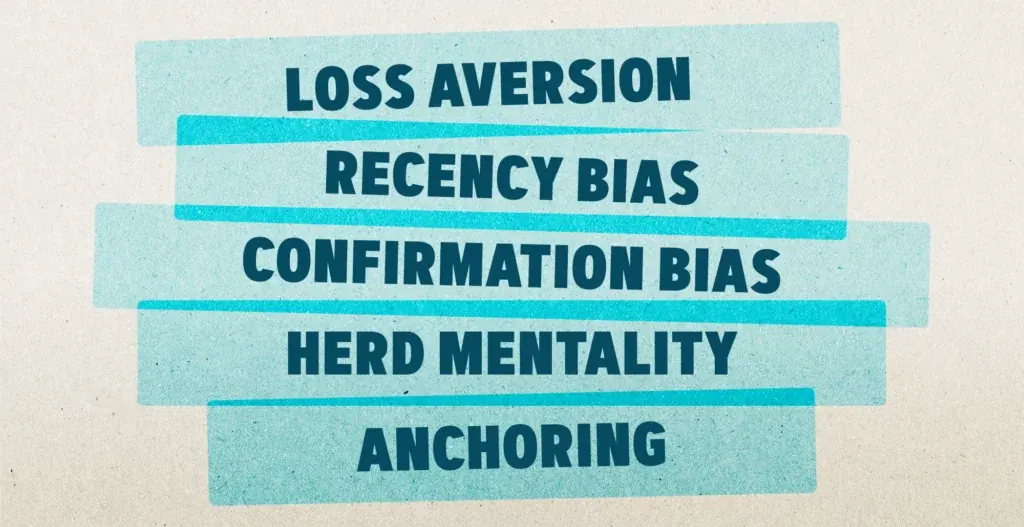
Beyond fear and greed, several specific psychological biases consistently lead investors astray.
Loss Aversion: Losses Hurt More Than Gains Feel Good
Loss aversion, identified by psychologists Daniel Kahneman and Amos Tversky, describes our tendency to feel the pain of losses roughly twice as strongly as we feel the pleasure of equivalent gains.
Losing $10,000 causes more psychological pain than gaining $10,000 causes pleasure. This asymmetry drives several destructive behaviors:
Holding Losers Too Long
Rather than accepting a loss and moving on, loss aversion makes us hold losing investments hoping they'll recover, refusing to realize the loss even when better opportunities exist elsewhere.
Selling Winners Too Soon
Conversely, we're quick to lock in gains on winning investments, taking small profits to secure the pleasure of "being right" while missing larger long-term gains.
Excessive Risk Avoidance
After experiencing losses, loss aversion can make us too conservative, avoiding reasonable risks and settling for returns that won't meet our long-term needs.
For retirees, loss aversion creates a particular challenge. You've spent decades building wealth. The thought of losing it feels unbearable, potentially causing you to make overly conservative choices that don't generate sufficient income or to panic sell during downturns when staying invested would serve you better.
Recency Bias: Overweighting Recent Events
Recency bias causes us to overweight recent experiences when making decisions, assuming current trends will continue indefinitely.
After a strong bull market, recency bias makes us believe stocks will continue rising forever. We increase equity exposure just as valuations peak. After a crash, recency bias convinces us markets will remain depressed, keeping us on the sidelines during recoveries.
This bias is why investor behavior during market volatility tends to be exactly backward. Recent fear drives selling after declines. Recent gains drive buying after increases.
An investor who lived through the 2008 financial crisis might remain overly fearful of stocks for years, even after conditions have normalized. Their recent traumatic experience colors all future decisions, causing them to avoid equities and miss subsequent gains.
Confirmation Bias: Seeing What We Want to See
Confirmation bias describes our tendency to seek information that confirms existing beliefs while ignoring contradictory evidence.
If you believe tech stocks are the future, you'll notice every article praising technology while dismissing warnings about valuations. If you believe the market will crash, you'll focus on negative indicators while ignoring positive economic data.
This bias prevents us from objectively evaluating our investment decisions and adjusting when evidence suggests we're wrong.
Herd Mentality: Following the Crowd
Humans are social creatures. We feel safety in numbers and discomfort going against the crowd. In investing, this manifests as herd mentality, doing what everyone else is doing simply because everyone else is doing it.
When your neighbors are bragging about their stock market gains, herd mentality makes you want to join in, regardless of whether it fits your strategy. When everyone is panicking and selling, herd mentality makes you want to sell too, even if your plan says to hold or buy.
The problem? The crowd is usually wrong at extremes. When everyone is euphoric and buying, markets are typically near peaks. When everyone is panicking and selling, markets are typically near bottoms.
Anchoring: Stuck on Irrelevant Numbers
Anchoring describes our tendency to fixate on specific numbers or prices, even when they're no longer relevant.
You bought stock at $100. It drops to $60. You refuse to sell because you're "anchored" to that $100 purchase price, convinced you need to "at least break even." But your purchase price is irrelevant to the stock's future prospects. The only question that matters is: would you buy this stock today at $60 knowing what you know now?
For retirees, anchoring often manifests in fixation on portfolio peaks. Your portfolio hit $800,000 before a decline to $650,000. You're anchored to that $800,000 number, feeling like you've "lost" money even though you may still be well ahead of where you started.
Real-World Examples: When Emotions Destroy Wealth
Understanding these biases academically is one thing. Seeing them play out in real situations drives the lesson home.
The 2008 Financial Crisis
The 2008 financial crisis provides a stark example of how psychology impacts investment decisions.
As the market crashed through late 2008 and early 2009, fear reached extreme levels. The S&P 500 fell 57% from peak to trough. Financial news predicted economic collapse. Investors panicked.
Those who sold near the bottom in March 2009, driven by fear that the decline would continue, locked in devastating losses. An investor with $500,000 who sold at the bottom had roughly $250,000 left.
Those who stayed invested, or better yet bought more, saw full recovery by 2013 and went on to enjoy one of the longest bull markets in history. By 2021, that same $500,000 would have grown to over $2 million simply by staying invested.
The difference? Psychology. The investments were the same. Emotional responses determine outcomes.
The Dot-Com Bubble
The late 1990s dot-com bubble illustrates how greed drives poor decisions.
As internet stocks soared, investors convinced themselves traditional valuation metrics no longer applied. Companies with no revenue traded at billion-dollar valuations. Investors mortgaged homes to buy tech stocks. Day trading became a popular career path.
Greed overrode every warning sign. When the bubble burst in 2000, the NASDAQ crashed 78%, wiping out trillions in wealth. Investors who chased performance lost everything, while those who maintained disciplined diversification survived and thrived.
COVID-19 March 2020
The COVID crash of March 2020 offers a more recent example. In just 23 trading days, the S&P 500 dropped 34% as pandemic fears peaked.
Investors who panicked and sold locked in massive losses. Those who remained calm and stayed invested saw full recovery within five months. The market reached new highs by August 2020, just five months after the bottom.
An investor who sold $300,000 at the March bottom and stayed in cash would have $300,000 today. An investor who stayed invested would have over $500,000. Psychology determined which group you were in.
How Successful Investors Think
If emotional reactions destroy returns, how do successful investors avoid these traps? They develop specific mental frameworks and habits that counteract natural psychological biases.
Process Over Outcomes
Successful investors focus on process, not outcomes. They know that good processes produce good long-term results, even if any individual outcome seems unfavorable.
They don't judge decisions based on short-term results. A well-reasoned investment that declines 20% in year one wasn't necessarily a bad decision. A lucky speculation that doubles wasn't necessarily a good decision.
This process orientation prevents knee-jerk reactions to short-term volatility and keeps investors focused on long-term fundamentals.
Long-Term Perspective
Successful investors think in decades, not days or months. They understand that short-term volatility is noise, long-term trends are signal.
A 10% decline in a given month means little if your investment horizon is 20 years. Markets fluctuate. That's normal. What matters is whether the long-term fundamentals supporting your investment remain intact.
This long-term perspective provides emotional stability during inevitable market turbulence.
Diversification as Emotional Protection
Beyond risk management, diversification provides psychological benefits. When one asset class declines, others may hold steady or increase, reducing the emotional impact of volatility.
Successful investors understand that diversification isn't just about returns, it's about creating a portfolio they can emotionally stick with during difficult periods.
Predetermined Rules and Discipline
Successful investors establish rules before emotions spike. They decide in advance:
- What percentage decline triggers buying more?
- What allocation changes occur at different life stages?
- What circumstances justify selling?
- How often to review and rebalance?
These predetermined rules remove emotional decision-making from the process. When fear or greed spike, you follow the plan, not your feelings.
Focusing on What They Can Control
Successful investors don't worry about market predictions, Federal Reserve decisions, or what stocks will do tomorrow. They focus on what they control:
- Asset allocation
- Costs and fees
- Tax efficiency
- Diversification
- Savings rate
- Investment time horizon
This focus on controllable factors reduces anxiety and prevents reactive decisions based on uncontrollable events.
Practical Strategies for Overcoming Fear in Investing Track Record Returns: A Decade of Consistency
Understanding psychology is valuable. Applying that understanding through specific strategies is what actually improves investor confidence and decision making.
Reduce Exposure to Financial Media
Financial news is engineered to provoke emotional responses. Fear and urgency drive clicks. Calm, patient investing doesn't make headlines.
Limit your consumption of financial news, especially during volatile periods. Check your portfolio quarterly, not daily. Read annual reports, not minute-by-minute market commentary.
This simple step dramatically reduces emotional volatility.
Automate Your Investment Process
Automation removes emotion from the equation. Set up automatic contributions to investment accounts. Automatic rebalancing according to predetermined allocations. Automatic reinvestment of dividends and distributions.
When decisions happen automatically according to pre-established rules, emotions can't interfere.
Focus on Income, Not Principal Fluctuations
For retirees, focusing on income rather than portfolio value reduces emotional stress. If your investments generate $40,000 annually in distributions, and that income remains stable, does it matter if the principal temporarily declines from $600,000 to $500,000?
This income-focused mindset, particularly when paired with investments that provide predictable cash flow from real assets rather than market-dependent dividends, helps you stay calm during market downturns.
Maintain Adequate Liquidity
Much fear during market declines stems from knowing you might need to sell at unfavorable prices. Maintaining 1-2 years of expenses in cash or short-term bonds eliminates this pressure.
When you know you can cover near-term needs without selling, you can emotionally tolerate market volatility much better.
Invest in What You Understand
Complexity breeds anxiety. When you don't understand how an investment works, every price movement triggers fear about what might be going wrong.
Investing in assets you understand, whether that's dividend stocks, real estate, bonds, or land-backed funds, provides confidence that helps you weather volatility.
Choose Investments That Match Your Psychology
Be honest about your risk tolerance and psychological makeup. If stock market volatility keeps you up at night and causes you to make emotional decisions, perhaps you shouldn't have 80% of your portfolio in equities, regardless of what conventional wisdom suggests.
Better to earn 8% annually while sleeping soundly than to aim for 10% while panic-selling during every correction.
Some investors find that real estate investments or asset-backed strategies provide the psychological comfort of tangible assets backing their investment, making it easier to remain calm during market turbulence.
How to Stay Calm During Market Downturns: A Practical Framework
When markets inevitably decline, use this framework to maintain composure and avoid destructive emotional decisions:
Step 1: Acknowledge Your Emotions
Don't pretend you're not feeling fear or anxiety. Acknowledge it. "I'm feeling scared because my portfolio dropped 15%." Naming emotions reduces their power over you.
Step 2: Separate Feeling from Thinking
Acknowledge that while you feel scared, your thinking mind recognizes this is normal market volatility. Feelings are valid. Acting on feelings without engaging rational thinking is dangerous.
Step 3: Review Your Plan
Pull out your written investment plan. Does it call for any action during market declines? If your plan says "rebalance annually" and you rebalanced three months ago, the plan says do nothing.
Following your predetermined plan prevents emotional decisions.
Step 4: Zoom Out
Look at long-term charts. See that markets have recovered from every previous decline. Recognize that today's scary drop is a small blip in a multi-decade journey.
Step 5: Focus on Fundamentals
Are the fundamental reasons you invested still valid? If you invested in dividend stocks for income, are the companies still paying dividends? If you invested in real estate for cash flow, is the cash flow still coming?
If fundamentals remain sound, price fluctuations are temporary noise.
Step 6: Take No Action
For most investors in most situations, the right action during market volatility is no action. Do nothing. Let time and fundamental value do their work.
Building Investor Confidence Through Knowledge
Much of investment fear stems from uncertainty and lack of understanding. Building knowledge in specific areas dramatically improves confidence:
Understand Market History
Knowing that markets have experienced crashes, wars, pandemics, and depressions yet still delivered positive long-term returns provides perspective during current difficulties.
Understand Your Specific Investments
The more you understand how your investments work, what drives their value, and what risks they face, the less scary volatility becomes.
Understand Your Financial Plan
When you have a comprehensive plan covering various scenarios, you feel confident you can handle whatever comes. Uncertainty breeds fear. Plans reduce uncertainty.
Understand Your Personal Psychology
Knowing your tendencies, recognizing your biases, and understanding your emotional triggers allows you to compensate for them proactively.

The Bottom Line: Psychology Determines Success
Technical analysis, fundamental research, asset allocation, all of these matter. But the psychology of investing ultimately determines whether you succeed or fail.
You can have the perfect investment strategy, but if you can't execute it during market turbulence, it's worthless. The investor who sticks with an average strategy outperforms the investor who abandons an excellent strategy at the first sign of trouble.
Understanding how psychology impacts investment decisions, recognizing your own biases and emotional triggers, and developing strategies for overcoming fear in investing are skills that compound over time. Each market cycle you successfully navigate strengthens your psychological foundation for the next one.
For retirees and near-retirees, mastering the psychology of investing is particularly crucial. You have less time to recover from emotional mistakes. You're dealing with the psychological stress of transitioning from wealth accumulation to wealth preservation and distribution. Getting psychology right matters more than ever.
The good news? These skills can be learned and developed. You can build the mental framework that separates successful investors from those who consistently underperform. It requires self-awareness, discipline, predetermined rules, and often choosing investment structures that match your psychological makeup.
Your investments will fluctuate. Markets will crash again. Fear and greed will tempt you to make emotional decisions. But armed with understanding of how psychology impacts your choices and practical strategies for maintaining discipline, you can avoid the behavioral traps that derail most investors.
The most successful investors aren't necessarily the smartest or those with the most information. They're the ones who manage their emotions, follow their plans, and think in decades rather than days. That capability is within reach for anyone willing to develop it.
If you’d like to learn more about how FISYN helps investors manage the ups and downs of successful investing, feel free to book a no-obligation phone call with one of our advisors.
Important Disclosure: This article is for educational purposes only and does not constitute financial advice. Past performance does not guarantee future results. All investments carry risk. Please consult with a qualified financial professional before making investment decisions.