
16 min read
What is an Annuity? A Complete Guide to How Annuities Work
Written on December 16, 2025 By Ron McVaney
Ready to start investing in Texas real estate?
Book Your Free Call Today
When it comes to retirement planning and generating steady income, annuities often come up in conversation with financial advisors. But what exactly is an annuity, and how do they work? More importantly, are annuities a good investment for your specific financial situation?
This comprehensive guide breaks down everything you need to know about annuities, from the basic mechanics to the various types available, along with the real pros and cons you should consider before committing your money.
What Is an Annuity?
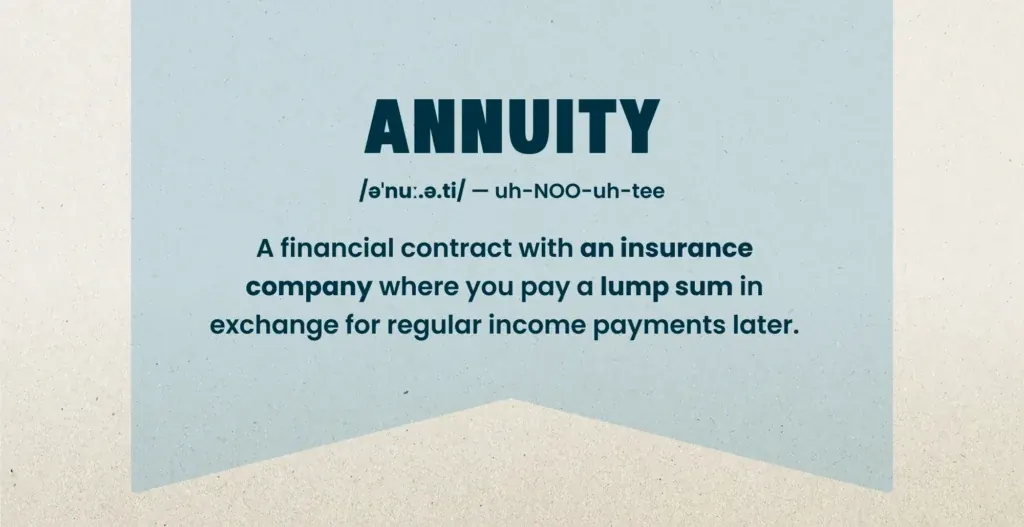
An annuity is a financial product, typically sold by insurance companies, that converts a lump sum of money into a stream of regular payments over time. Think of it as a contract where you pay money upfront (or over time) in exchange for guaranteed income later, often during retirement.
The fundamental promise is simple: you give an insurance company a sum of money, and in return, they provide you with regular payments for a specified period or for the rest of your life.
Annuities were originally designed to address one of retirement's biggest fears: outliving your money. By providing predictable income, they offer a sense of financial security that some investors find appealing.
How Annuities Work: The Basic Mechanics
Understanding how annuities work requires looking at two distinct phases:
The Accumulation Phase
During this period, you contribute money to the annuity. You can make:
- A single lump-sum payment
- Multiple payments over time
- Regular periodic contributions
Your money grows tax-deferred during this phase, meaning you won't pay taxes on earnings until you start receiving payments.
The Distribution Phase
This is when the annuity begins paying you back. You can choose to receive:
- Monthly payments
- Quarterly payments
- Annual payments
- A lump sum (though this often comes with penalties)
The amount you receive depends on several factors: how much you contributed, how long the money has been growing, the type of annuity you selected, and the payout option you choose.
How Annuities Generate Income
Annuities generate income through a combination of your principal investment and the returns earned on that investment. Insurance companies pool money from many annuity holders and invest it in various assets like bonds, stocks, and real estate.
The insurance company takes on the risk of managing these investments and guarantees you a certain level of return or income stream, regardless of how their underlying investments perform. This guarantee is one of the primary selling points of annuities, but it comes at a cost in the form of fees and potentially lower returns than you might achieve through direct investing.
The insurance company profits by keeping the difference between what they earn on investments and what they pay out to annuity holders, plus the various fees they charge.
Types of Annuities Explained
Not all annuities are created equal. Understanding the different types of annuities is critical to determining whether one might fit your financial goals.
Immediate vs. Deferred Annuities
Immediate Annuities You make a single lump-sum payment and begin receiving income almost immediately, typically within a year. These are popular with people who have just retired and want to convert a retirement account or other assets into steady income right away.
Deferred Annuities You make contributions over time, and the payout phase begins at a future date you specify. This allows your money to grow tax-deferred for years or even decades before you start taking distributions.
Fixed vs. Variable Annuities
This is one of the most important distinctions when evaluating annuities.
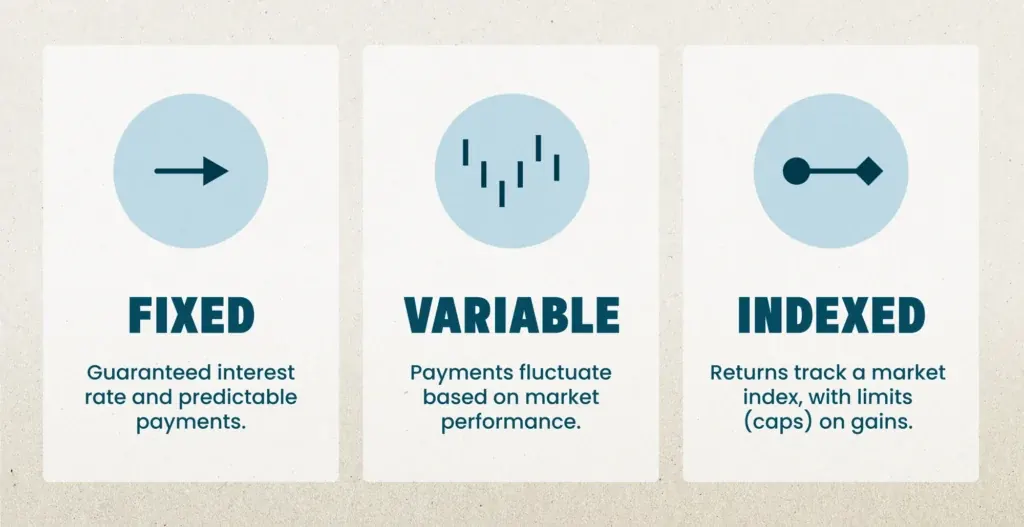
Fixed Annuities With a fixed annuity, the insurance company guarantees a specific rate of return during the accumulation phase and a predictable payment amount during the distribution phase. Your payments won't fluctuate based on market performance.
The appeal: predictability and safety. You know exactly what you're getting.
The downside: lower potential returns. Fixed annuities typically offer modest growth that may not keep pace with inflation over time.
Variable Annuities Variable annuities tie your returns to the performance of underlying investments, typically mutual funds. Your account value and eventual payments can go up or down based on market performance.
The appeal: higher growth potential if the market performs well.
The downside: market risk. Your account value can decrease, and you may receive lower payments than expected. Variable annuities also tend to have higher fees than fixed annuities.
Indexed Annuities
Indexed annuities (also called fixed-indexed or equity-indexed annuities) fall somewhere between fixed and variable annuities. Your returns are tied to a market index like the S&P 500, but with a guaranteed minimum return and a cap on maximum gains.
These products are complex and often come with participation rates, caps, and spreads that limit your upside potential while still exposing you to some level of risk.
Annuity Payout Options
When it's time to start receiving income, you'll need to choose how you want to be paid. Common options include:
Life Only (Straight Life) Payments continue for as long as you live but stop when you die, even if that's just a few years after starting. This provides the highest monthly payment but offers no benefits to heirs.
Life with Period Certain Payments continue for your life, but if you die before a specified period (such as 10 or 20 years), your beneficiary receives payments for the remainder of that period.
Joint and Survivor Payments continue as long as either you or your spouse is alive. Monthly payments are typically lower than single-life options.
Period Certain Payments are guaranteed for a specific period, regardless of whether you're alive. If you die before the period ends, your beneficiary receives the remaining payments.
Annuity Tax Implications
Understanding annuity tax implications is essential before investing, as the tax treatment can significantly impact your net returns.
Tax-Deferred Growth
During the accumulation phase, your money grows tax-deferred. You won't pay taxes on interest, dividends, or capital gains as they accumulate inside the annuity. This can be advantageous for long-term growth.
Taxation of Withdrawals
When you withdraw money from an annuity, the tax treatment depends on how the annuity was funded:
Non-Qualified Annuities (funded with after-tax dollars) Withdrawals are taxed on a last-in, first-out (LIFO) basis. This means earnings come out first and are taxed as ordinary income. Once you've withdrawn all the earnings, subsequent withdrawals of your principal are tax-free since you already paid taxes on that money.
Qualified Annuities (funded with pre-tax dollars from IRAs or 401(k)s) All withdrawals are taxed as ordinary income since you haven't paid taxes on any of the money yet.
Ordinary Income Tax Rates
A significant drawback: annuity earnings are taxed as ordinary income, not at the more favorable long-term capital gains rates. Depending on your tax bracket, this can result in paying significantly more in taxes compared to other investment vehicles.
Early Withdrawal Penalties
If you withdraw money before age 59½, you'll typically owe a 10% IRS penalty in addition to ordinary income taxes on the earnings portion of your withdrawal. There are some exceptions for disability or death.
Annuity Withdrawal Rules
Beyond tax implications, annuities come with strict withdrawal rules that can limit your access to your own money.
Surrender Charges
Most annuities have surrender periods, typically lasting 5 to 10 years or longer. If you withdraw more than a specified amount during this period (often 10% of your account value per year), you'll face surrender charges that can range from 5% to 10% or more of the withdrawn amount.
Free Withdrawal Provisions
Many annuities allow you to withdraw up to 10% of your account value each year without surrender charges, but you'll still owe any applicable taxes and IRS penalties if you're under 59½.
Required Minimum Distributions (RMDs)
If your annuity is held in a qualified retirement account like an IRA, you must begin taking required minimum distributions at age 73 (as of 2024), regardless of whether you need the income. Failure to take RMDs results in significant IRS penalties.

Pros and Cons of Annuities
Let's examine both sides of the annuity equation to help you make an informed decision.
Advantages of Annuities
Guaranteed Income The primary benefit is predictable income. Knowing you'll receive a check every month can provide peace of mind, especially if you're worried about outliving your savings.
Tax-Deferred Growth Your money grows without annual tax bills, potentially allowing for greater compound growth over time.
No Contribution Limits Unlike IRAs and 401(k)s, there's no annual limit on how much you can contribute to a non-qualified annuity.
Protection from Market Volatility Fixed annuities provide stability and protection from market downturns, which can be appealing as you approach or enter retirement.
Death Benefit Options Many annuities offer death benefits that guarantee your beneficiaries will receive at least your initial investment, even if the account value has declined.
Disadvantages of Annuities
Misaligned Incentives and Commission Conflicts The annuity industry operates on a fundamental conflict of interest. Agents selling annuities typically earn commissions of 5% to 8% or more of your investment, paid upfront by the insurance company. A $200,000 annuity sale can generate $10,000 to $16,000 in immediate commission for the agent.
This creates a powerful incentive to sell annuities whether or not they're the best solution for your situation. The agent gets paid the same whether the annuity serves your needs or not, and they get paid more for selling products with higher commissions, which often correlate with higher fees and more restrictions for you.
Even more concerning, many annuity agents can begin selling these complex financial products with minimal qualifications. Someone can become licensed to sell annuities after a short training course and passing a basic exam, with no requirement for prior investment experience, financial planning expertise, or demonstrated knowledge of markets. Would you trust major financial decisions to someone who was selling cars last month and annuities this month?
Disappearing Agents Once the commission is paid, many agents vanish. The enthusiastic advisor who called you regularly before the sale suddenly becomes difficult to reach afterward. You're left holding a complex contract you may not fully understand, with questions that go unanswered and concerns that get dismissed.
This post-sale abandonment isn't universal, but it's common enough to be a serious concern. The agent's incentive was the upfront commission, not your long-term success. Once that commission is earned, you're often on your own.
Excessive and Punitive Surrender Charges Let's be blunt about surrender charges: they're designed to trap your money and punish you severely for needing access to your own funds. Charges of 7% to 10% in early years aren't uncommon, and some contracts impose even higher penalties.
These aren't reasonable fees for administrative costs. They're mechanisms to ensure the insurance company recovers the massive commission they paid the agent, plus their own profits, even if the product doesn't serve you well. You're essentially paying back the agent's commission through surrender charges if you try to escape a bad decision.
A 10-year surrender period with high early penalties means the insurance company is betting you'll either stick it out (even if it's not working for you) or pay dearly to leave. That's not a partnership, it's a trap.
Excessive Fees That Compound Over Time Annuities, particularly variable annuities, charge layer upon layer of fees that steadily erode your returns. Mortality and expense charges, administrative fees, investment management fees, and optional rider fees can easily total 2.5% to 3.5% annually or more.
These fees might not sound devastating in isolation, but they compound over decades into six-figure wealth transfers from you to the insurance company. A $200,000 investment losing 3% annually to fees means $6,000 gone in year one, but over 20 years you've paid over $150,000 in total fees (assuming modest growth). That's money that could have been compounding for your benefit.
The insurance company and agent profit handsomely from these fees. You pay them regardless of performance, whether your account grows or shrinks, whether you're happy with the product or not.
Impenetrable Complexity Annuity contracts routinely run 50 to 100 pages of dense legal and financial language designed more to protect the insurance company than to inform you. Terms are buried in footnotes. Exceptions have exceptions. Critical details are obscured by jargon.
This complexity isn't accidental. It makes comparison shopping nearly impossible and hides unfavorable terms that might cause you to reconsider the purchase. How can you make an informed decision about a product you can't fully understand even after reading the contract multiple times?
Even financially sophisticated investors struggle to decode these contracts. For average investors, it's nearly impossible to truly understand what they're buying, what it will cost, and what restrictions they're accepting.
Severely Limited Liquidity Surrender charges and withdrawal restrictions effectively lock up your money for a decade or longer. Life is unpredictable. Job losses happen. Medical emergencies occur. Business opportunities arise. Family situations change.
Yet your annuity punishes you for accessing your own money to address these realities. The 10% free withdrawal provision sounds generous until you realize that anything beyond that 10% triggers massive penalties. Need $50,000 from your $200,000 annuity? You can take $20,000 without surrender charges, but that other $30,000 will cost you thousands in penalties.
This illiquidity represents a fundamental loss of control over your financial life. The insurance company benefits from locking up your capital. You bear all the risk of needing money you can't access without severe penalties.
Disappointing Returns After Fees Despite the complex investment strategies and promises of growth, annuities frequently deliver disappointing returns once you account for all the fees. Fixed annuities offer returns that barely exceed inflation. Variable annuities, despite market exposure, often lag simple index funds by 2% to 3% annually due to their fee drag.
That performance gap compounds over time into enormous differences in wealth. Over 20 or 30 years, the difference between 7% returns (typical annuity after fees) and 10% returns (typical low-cost index fund) can mean hundreds of thousands of dollars less in your account.
You're paying high fees for professional management that often underperforms passive investments charging a fraction of the cost. The insurance company and agent get rich. Your wealth grows more slowly than it should.
Inflation Risk Without Expensive Riders Fixed annuity payments sound attractive until you realize inflation steadily erodes their purchasing power. A $3,000 monthly payment today will buy significantly less in 20 years. Yet fixed annuities provide no inflation adjustment unless you purchase an expensive inflation rider that reduces your initial payments substantially.
You're forced to choose between higher payments now that lose value over time, or lower payments now with inflation protection you're paying dearly for. Either way, the insurance company wins.
Loss of Control and Flexibility Once you commit to an annuity, especially after annuitizing, you've surrendered control. You can't change strategies if better opportunities emerge. You can't adjust to changing life circumstances without penalties. You can't access your principal freely.
This loss of flexibility has real costs. Investment opportunities you can't pursue. Financial challenges you can't address efficiently. Life changes you can't adapt to without paying penalties. All because you locked yourself into a rigid structure that serves the insurance company's interests more than yours.
Counterparty Risk Your annuity income depends entirely on the insurance company's financial strength. If the company fails, you could lose some or all of your investment. While state guaranty associations provide some protection (typically $250,000, varying by state), this safety net is less robust than FDIC insurance and may not fully protect larger investments.
You're trusting a single company with potentially your entire retirement security, hoping they remain solvent for decades. That's significant concentration risk that diversified investments don't carry.
Are Annuities a Good Investment?
The question of whether annuities are a good investment doesn't have a simple yes or no answer. It depends entirely on your individual financial situation, goals, risk tolerance, and what alternatives are available.
When Annuities Might Make Sense
Annuities may be appropriate if you:
- Have maximized contributions to tax-advantaged retirement accounts and want additional tax-deferred growth
- Have a strong aversion to market risk and value guaranteed income above growth potential
- Lack pension income and want to create a pension-like income stream
- Have longevity in your family and are concerned about outliving your assets
- Have sufficient liquid assets set aside for emergencies and don't need access to the annuity funds
When to Think Twice About Annuities
Annuities may not be suitable if you:
- Are young and have decades until retirement (the fees will compound and significantly reduce long-term wealth)
- Need flexibility and access to your funds
- Can achieve your retirement goals through lower-cost investment vehicles
- Don't fully understand the product being sold to you
- Are being pressured by a commissioned salesperson
- Have a shorter life expectancy due to health issues
The Commission Problem
It's worth noting that annuities often pay high commissions to the salespeople who sell them, sometimes 5% to 8% or more of your investment. This creates an inherent conflict of interest. The person recommending an annuity may be more motivated by their commission than by what's truly best for your financial future.
Ron has seen his fair share of horror stories as it relates to insurance salespeople making out like bandits, all for their commission. If you’re curious to learn more, register for Ron’s free Annuities Webinar Presentation, and hear the stories for yourself.
Always ask: "How are you compensated for selling this product?" and "What alternatives did you consider before recommending an annuity?"
The salesperson's answer should tell you all you need to know.
Alternatives to Consider
Before committing to an annuity, consider whether other investment vehicles might better serve your needs:
Diversified Investment Portfolio A balanced mix of stocks and bonds historically provides better long-term returns with more flexibility and lower fees than most annuities.
Bond Ladders Creating a ladder of bonds with staggered maturity dates can provide predictable income with more liquidity and transparency than annuities.
Dividend-Paying Stocks Quality dividend stocks can provide growing income that keeps pace with or exceeds inflation, plus the potential for capital appreciation.
Real Estate Investments Income-producing real estate can offer both regular cash flow and equity appreciation. For investors seeking passive real estate exposure without property management responsibilities, alternative structures like land-backed investments provide asset-backed security with potentially higher yields than annuities.
If you’re curious how this works, book a quick no-obligation call with one of our specialists, and they can share with you how our land-backed investment can shape your retirement.
Systematic Withdrawal Plans You can create your own "annuity" by systematically withdrawing from a diversified portfolio. Studies show that a well-managed withdrawal strategy often outperforms annuity purchases over time.
Questions to Ask Before Buying an Annuity
- If you're considering an annuity, ask these critical questions:
- What are ALL the fees associated with this annuity, and how do they compound over time?
- What is the surrender period, and what are the penalties for early withdrawal?
- What happens to my money if I die during the accumulation phase?
- What is the financial strength rating of the insurance company?
- How does the guaranteed return compare to current bond yields and historical stock market returns?
- What are my alternatives, and how do they compare after fees and taxes?
- Can you show me illustrations with both optimistic and pessimistic scenarios?
- How are you compensated for selling this product?
The Bottom Line
Annuities are complex financial products that serve a specific purpose: converting a lump sum into guaranteed income. For some investors, particularly those with low risk tolerance and specific income needs, annuities can play a role in a comprehensive retirement plan.
However, the high fees, limited liquidity, complexity, and often lower returns compared to alternatives mean annuities aren't the right choice for everyone. In many cases, you can achieve similar or better results with more flexibility and lower costs through other investment strategies.
The key is understanding exactly what you're buying, what you're giving up, and whether the guarantees are worth the trade-offs. Never purchase an annuity based on a sales pitch alone. Take the time to review the contract, compare alternatives, and ideally, consult with a fee-only financial advisor who doesn't earn commissions from product sales.
Your retirement security is too important to rush into any decision, especially one that could lock up your money for a decade or more.
If you’d like to discuss your current annuity, or explore your options, go ahead and book a short, no-obligation call with one of our investment consultants today.
Important Disclosure: This article is for educational purposes only and does not constitute financial or tax advice. Past performance does not guarantee future results. All investments carry risk, including the potential loss of principal. Real estate investments are typically illiquid and may not be suitable for all investors. The targeted returns and distribution rates discussed are targets and not guarantees. Please consult with a qualified financial professional before making investment decisions.