
16 min read
Fixed vs Variable Annuities: What Are They and Which Carries More Risks
Written on March 13, 2026 By Ron McVaney
Ready to start investing in Texas real estate?
Book Your Free Call Today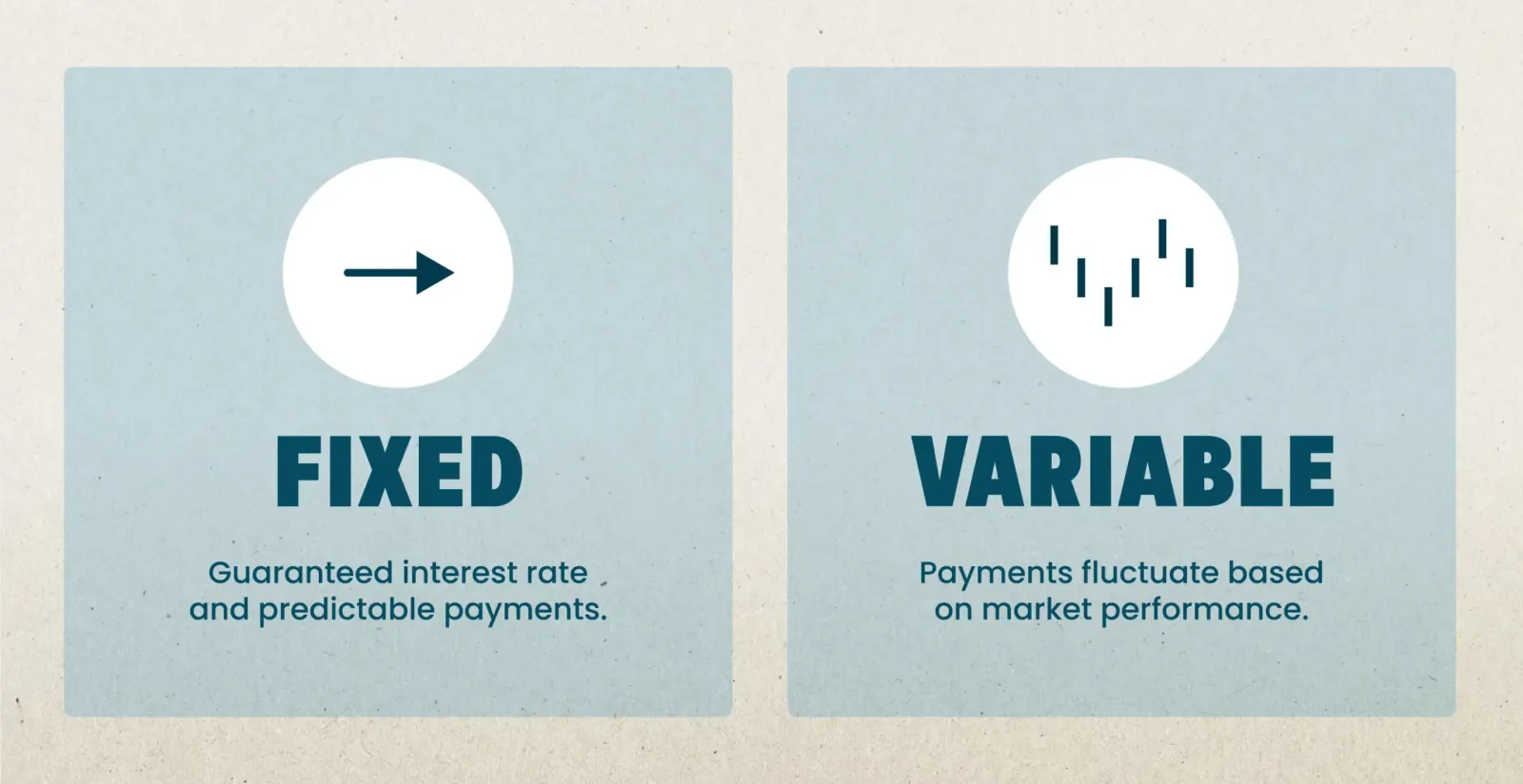
When considering annuities for retirement income, most investors face a fundamental choice: fixed or variable. Insurance agents present these as your primary options, each with distinct characteristics, benefits, and risks. Understanding the differences between fixed vs variable annuities is critical before committing potentially hundreds of thousands of retirement dollars.
This comprehensive comparison examines both annuity types, analyzes their respective risks, and explores whether either truly represents the best choice for retirement income. The conclusion may surprise you: the question isn't which annuity is better, but whether annuities as a category serve your interests as well as available alternatives.
What Are Fixed Annuities?
Fixed annuities represent the simpler, more straightforward annuity structure. When you purchase a fixed annuity, you exchange a lump sum for either immediate or future guaranteed payments at a predetermined rate.
How Fixed Annuities Work
During the accumulation phase, your money earns a guaranteed interest rate set by the insurance company, typically ranging from 2% to 5% depending on market conditions and contract terms. This rate may be fixed for the entire contract period or may change periodically according to contract provisions.
The insurance company invests your premium in conservative assets like bonds and maintains reserves to meet their guaranteed obligations. Your account grows at the stated rate regardless of actual investment performance, with the insurance company absorbing investment risk.
When you annuitize (convert to income payments), the insurance company calculates your payment amount based on your account value, life expectancy, and their payout rates. These payments then continue for the period specified in your contract, whether that's a fixed number of years or your lifetime.
How Fixed Annuities Generate Income
Fixed annuities generate income through two mechanisms. First, the insurance company invests your premium in bonds and other fixed-income securities, earning returns that exceed what they credit to your account. This spread between what they earn and what they pay you represents their profit.
Second, once annuitized, fixed annuities use mortality credits. Not everyone lives to their full life expectancy. Those who die earlier than expected subsidize payments to those who live longer. The insurance company pools this longevity risk across thousands of contract holders, using actuarial calculations to ensure profitability while providing lifetime income guarantees.
Your guaranteed payments come from your own principal, investment returns on that principal, and the mortality credit pool, all managed by the insurance company in exchange for fees built into the contract structure.
Fixed Annuity Risks
Despite the "guaranteed" label, fixed annuities carry significant risks:
Inflation Risk
Fixed payments lose purchasing power over time. A $3,000 monthly payment adequate today becomes insufficient as living costs rise. Over twenty or thirty years of retirement, inflation can devastate fixed income's real value.
Counterparty Risk
Your payments depend entirely on the insurance company remaining solvent. Company failure could jeopardize your income, with state guaranty associations providing only limited protection.
Liquidity Risk
Surrender charges trap your money for years, often a decade or more. Accessing funds early triggers substantial penalties that can consume 5% to 10% of your account value.
Opportunity Cost
The guaranteed rate typically trails returns available from balanced portfolios over time. The safety of knowing your rate comes at the expense of growth potential.
What Are Variable Annuities?
Variable annuities represent a more complex structure that attempts to combine market participation with insurance features. They offer potential for higher returns than fixed annuities but with correspondingly higher risks and costs.
How Variable Annuities Work
With variable annuities, your premium invests in sub-accounts that function similarly to mutual funds, offering exposure to stocks, bonds, and other asset classes. Your account value fluctuates with market performance, rising when investments perform well and falling when they don't.
Insurance companies offer various optional riders and guarantees for additional fees, including guaranteed minimum income benefits, death benefits, and withdrawal benefits. These riders attempt to provide downside protection while maintaining upside potential.
The fundamental structure differs from fixed annuities. Rather than guaranteeing a specific return, variable annuities provide market exposure wrapped in an insurance contract, with optional guarantees available for extra cost.
How Variable Annuities Generate Income
Variable annuities generate income through investment returns on the underlying sub-accounts. If your stock and bond sub-accounts perform well, your account value grows. You can then take systematic withdrawals or annuitize the accumulated value into guaranteed payments.
Optional income riders, purchased for additional annual fees, may guarantee minimum withdrawal amounts regardless of account performance. For example, a guaranteed withdrawal benefit might promise you can withdraw 5% annually for life even if your account value drops to zero due to poor investment performance or excessive withdrawals.
The insurance company profits from variable annuities through multiple fee layers: mortality and expense charges, administrative fees, sub-account management fees, and rider fees. These stack up quickly, often totaling 2.5% to 3.5% or more annually.
Variable Annuity Risks
Variable annuities carry all fixed annuity risks plus additional concerns:
Market Risk
Your account value fluctuates with investment performance. Poor market timing or extended bear markets can significantly reduce your accumulated value and future income potential.
Complexity Risk
Variable annuity contracts are extraordinarily complex, making true cost-benefit analysis nearly impossible for most investors. You may not fully understand what you own or what you're paying for.
Fee Risk
The multiple fee layers create significant drag on returns. Even with good underlying investment performance, net returns after all fees often disappoint.
Rider Cost
The optional guarantees that make variable annuities appear attractive carry substantial ongoing costs. These fees continue whether you use the benefits or not, and they compound over decades.
Fixed vs Variable Annuities: Direct Comparison
Examining fixed and variable annuities side by side reveals their respective strengths and weaknesses.
Return Potential
Fixed Annuities: Predictable but limited returns typically in the 2% to 5% range. You know what you'll get, but growth is modest and often trails inflation plus other investment alternatives.
Variable Annuities: Potential for higher returns through market exposure, but no guarantees. Sub-account performance minus substantial fees determines actual returns, which may or may not exceed fixed annuity rates.
Winner: Variable annuities have higher potential returns, but fixed annuities offer more certainty. Neither consistently outperforms low-cost balanced portfolios after accounting for fees.
Risk Profile
Fixed Annuities: Lower market risk but high inflation risk and moderate counterparty risk. You won't lose principal to market fluctuations, but purchasing power erosion and insurance company dependence create different dangers.
Variable Annuities: Higher market risk, high complexity risk, and high fee risk in addition to counterparty and inflation concerns. More ways to lose money or underperform.
Winner: Fixed annuities carry fewer types of risk, though inflation risk alone can be devastating. Variable annuities expose you to more potential problems.
Cost Structure
Fixed Annuities: Costs are built into credited rates rather than explicitly charged as separate fees. The spread between what the insurance company earns and what they credit you represents their profit, plus surrender charges if you exit early.
Variable Annuities: Explicit fee layers that can easily total 2.5% to 3.5% annually or more, plus surrender charges. These ongoing costs dramatically impact long-term returns.
Winner: Fixed annuities have simpler, lower explicit costs, though the implicit cost of low credited rates may equal or exceed variable annuity fees over time.
Flexibility
Fixed Annuities: Rigid structure with predetermined rates and payment schedules. Limited ability to adjust to changing circumstances beyond standard free withdrawal provisions.
Variable Annuities: Slightly more flexibility in investment allocation among sub-accounts and withdrawal timing, but still constrained by surrender charges and complex rider provisions.
Winner: Both offer poor flexibility. Neither allows the adaptability that changing life circumstances often require.
Transparency
Fixed Annuities: Relatively straightforward contracts with clear rate and payment structures, though surrender charge schedules can be opaque.
Variable Annuities: Complex contracts with multiple moving parts, optional riders with intricate terms, and fee structures that obscure true costs.
Winner: Fixed annuities are simpler to understand, though neither offers the transparency of directly owned investments.

Which Carries More Risks?
Evaluating which type carries more risk depends on how you define risk and what concerns you most.
Short-Term Risk
Variable annuities carry more short-term risk due to market exposure. Your account value can decline significantly in market downturns, creating potential losses that fixed annuities avoid through guaranteed credited rates.
For investors prioritizing principal protection and stability, fixed annuities present lower short-term risk.
Long-Term Risk
Over longer time horizons, fixed annuities arguably carry more risk due to inflation. The certainty of fixed payments becomes a liability when purchasing power erodes by 30%, 40%, or 50% over decades of retirement.
Variable annuities at least offer potential for returns that keep pace with or exceed inflation, though high fees and market volatility may undermine this advantage.
Overall Risk Assessment
From a comprehensive risk perspective, both annuity types carry substantial risks that investors often underestimate:
Both depend on insurance company solvency (counterparty risk). Both impose liquidity restrictions through surrender charges (access risk). Both come with high costs relative to alternatives, whether explicit fees or implicit opportunity costs (financial risk). Both lock you into decisions made years earlier with limited ability to adapt (flexibility risk).
The question of which carries more risk has no universal answer. It depends on your specific situation, risk tolerance, and which risks you're most equipped to handle. What's clear is that both carry significant risks that extend beyond simple market volatility.

How Safe Are Annuities? Both Types Evaluated
When evaluating how safe are annuities, we must consider safety across multiple dimensions, not just principal protection.
Principal Safety
Fixed annuities protect principal from market risk, making them "safe" in the sense that your account won't decline due to stock market crashes. Variable annuities expose principal to market risk, trading safety for growth potential.
However, both rely on insurance company strength. If the issuing company fails, your principal protection or market exposure becomes irrelevant. You're dependent on corporate solvency and state guaranty association backup.
Income Safety
Both annuity types can provide guaranteed lifetime income once annuitized, making them "safe" from the perspective of not outliving your money. This longevity insurance represents annuities' primary value proposition.
Yet income safety must account for purchasing power. Guaranteed income that loses half its real value to inflation isn't truly safe. You won't run out of dollars, but those dollars may prove insufficient for your needs.
Access Safety
Neither annuity type provides safe, penalty-free access to your funds during surrender periods. This liquidity restriction creates genuine financial vulnerability when unexpected needs arise.
The "safety" of locked-up money that you cannot access without devastating penalties is questionable at best.
The Verdict on Safety
Annuities provide certain types of safety (principal protection for fixed, longevity insurance for both) while exposing you to other significant risks (inflation, illiquidity, counterparty dependence, high costs). Whether this trade-off represents genuine safety depends on your definition and priorities.
For many investors, the risks annuities present outweigh the safety they provide.
Best Annuities for Retirement: The Uncomfortable Truth
Insurance agents and financial advisors who sell annuities will debate whether fixed or variable represents the best annuities for retirement. The more fundamental question is whether either type truly serves your interests.
The Case Against Fixed Annuities
Fixed annuities offer peace of mind through guaranteed rates and predictable payments, but at tremendous cost. Inflation steadily destroys purchasing power. Low credited rates lag balanced portfolio returns. Surrender charges trap your money. You're dependent on insurance company solvency.
For the safety of predictability, you sacrifice growth, flexibility, and purchasing power protection. This trade-off rarely works in your favor over multi-decade retirements.
The Case Against Variable Annuities
Variable annuities promise market upside with downside protection, but deliver poor execution. High fees consume returns. Complex riders cost more than they're worth. You're taking market risk anyway, so why not own investments directly without the insurance wrapper and its costs?
The theoretical benefits of variable annuities fail to materialize for most investors once you account for fees, restrictions, and complexity.
Neither Is Ideal
The uncomfortable truth is that neither fixed nor variable annuities represent optimal retirement income solutions for most investors. Both impose unnecessary costs, restrictions, and risks in exchange for guarantees that often prove less valuable than advertised.
The real question isn't "which annuity type is better" but rather "are there better alternatives to annuities entirely."
Annuity vs Life Insurance: Clearing Up the Confusion
Annuities and life insurance are often confused because both are insurance products, but they serve opposite purposes and function very differently.
Fundamental Purpose Difference
Life insurance protects against dying too soon. You pay premiums to provide financial security for your beneficiaries if you die prematurely. The insurance company pays out when you die, compensating your family for lost income and financial support.
Annuities protect against living too long. You pay a lump sum to ensure you don't outlive your money. The insurance company pays out while you're alive, providing guaranteed income for as long as you live.
They're financial opposites: life insurance for premature death, annuities for extended longevity.
Why the Confusion Exists
The confusion stems from several factors. Both are insurance products sold by similar agents and companies. Both involve contracts with insurance companies and use actuarial calculations. Some products blur the lines with hybrid features combining elements of both.
Cash value life insurance policies have savings components that accumulate value, making them seem similar to annuities' accumulation phase. Some annuities offer death benefits, making them seem like life insurance. Marketing materials don't always clarify the distinctions.
Key Differences
Payment Direction: Life insurance pays beneficiaries after your death. Annuities pay you during your life.
Purpose: Life insurance replaces lost income for dependents. Annuities provide retirement income for yourself.
When You Need It: Life insurance matters most when you have dependents relying on your income. Annuities matter most in retirement when you're concerned about outliving assets.
Tax Treatment: Life insurance death benefits are generally tax-free to beneficiaries. Annuity distributions face ordinary income taxation on earnings.
Understanding these differences prevents purchasing the wrong product for your needs or being confused by hybrid products that attempt to serve both purposes, usually poorly.
Alternatives to Fixed Annuities: Better Options for Retirement Income
Rather than choosing between fixed and variable annuities, consider whether these alternatives better serve your retirement income needs.
Dividend Growth Portfolios
Quality dividend-paying stocks provide growing income streams that naturally keep pace with inflation. Unlike fixed annuity payments that stagnate, dividend income from strong companies tends to increase over time.
This approach offers complete flexibility and liquidity. You maintain control of your principal, can adjust strategies as circumstances change, and leave remaining assets to heirs. Dividend income receives favorable tax treatment compared to annuity distributions.
The trade-off is accepting market volatility and assuming responsibility for investment management rather than outsourcing these to an insurance company.
Bond Ladders and Fixed Income Portfolios
For investors who want predictable income without annuity restrictions, bond ladders provide annuity-like cash flow with superior transparency and control.
You own individual bonds directly, know exactly what you'll receive in interest and principal, and face no surrender charges or insurance company counterparty risk. When bonds mature, you can reinvest or use the principal as needed.
Bond ladders require more capital to properly diversify and lack the longevity insurance of annuities, but provide far better liquidity and transparency.
Systematic Withdrawal Strategies
Creating your own "annuity" through systematic withdrawals from diversified portfolios often outperforms purchased annuities over time. Research suggests properly managed withdrawal strategies provide comparable or superior outcomes without annuity costs and restrictions.
This approach maximizes flexibility, preserves assets for heirs, and avoids insurance company fees and surrender charges. You bear market risk but maintain control and adaptability.
Real Asset-Backed Investment Funds
For investors seeking passive income with tangible asset backing, real asset-backed investment funds offer compelling alternatives to both fixed and variable annuities.
Rather than depending on insurance company promises or stock market performance, these funds invest in real assets like commercial land, providing income from actual property cash flows and appreciation potential from value-enhancing strategies.

FISYN as an Alternative: Specific Reasons to Consider
FISYN's land-backed investment approach represents one alternative worth considering for investors seeking retirement income without annuity drawbacks.
Real Asset Backing vs Insurance Promises
Unlike annuities where you're depending on insurance company guarantees, FISYN investments are backed by actual Texas commercial land. Your capital invests in tangible real estate assets that hold value independent of corporate promises or market sentiment.
This fundamental difference provides downside protection through real asset value rather than contractual obligations. Land doesn't disappear. Property maintains intrinsic worth even when financial markets fluctuate.
Income Without Surrender Charges
FISYN's structure provides monthly income distributions without the surrender charges that trap annuity investors. While real estate investments have their own liquidity considerations, you're not paying 5% to 10% penalties to access your own money.
This improved liquidity matters when life circumstances change or opportunities arise requiring capital access.
Inflation Protection Through Real Assets
Real estate historically appreciates with inflation, providing natural purchasing power protection that fixed annuities lack. As land values rise with economic growth and development pressure, your underlying asset base maintains real value.
FISYN's strategy of acquiring land, enhancing value through rezoning and entitlement, and selling at multiples of purchase price aims to generate returns that exceed inflation significantly, protecting purchasing power over time.
No Complex Fee Structures
Unlike variable annuities with their layers of mortality charges, administrative fees, sub-account expenses, and rider costs, FISYN operates with transparent fee structures focused on property-level expenses and management.
You're not paying insurance company overhead, agent commissions built into credited rates, or complex rider fees. The costs relate directly to real estate operations and professional management.
Active Value Creation vs Passive Guarantees
Rather than accepting whatever the insurance company decides to credit your account or hoping sub-accounts perform well, FISYN actively creates value through strategic land enhancement.
The investment model doesn't wait for market appreciation. It deliberately transforms agricultural or lower-use land into development-ready sites, creating value that developers pay premiums to acquire.
This active approach to returns contrasts with annuities' passive structure of accepting whatever rates the insurance company offers or whatever the market delivers.
Professional Management Without Insurance Constraints
FISYN provides professional management of real estate investments without the insurance company intermediary that adds costs and complexity to annuities.
You're investing directly in a strategy focused on land acquisition and enhancement, not filtering everything through an insurance contract wrapper that serves the company's interests as much as yours.
Who Should Consider FISYN vs Annuities
FISYN makes sense for investors who:
- Want passive income without annuity surrender charges
- Prefer real asset backing over insurance company promises
- Seek inflation protection through real property appreciation
- Value transparency over complex insurance contracts
- Can meet investment minimums ($1,000 for Regulation A, $25,000 for Regulation D)
- Accept real estate market risk in exchange for avoiding annuity restrictions
FISYN isn't appropriate for everyone, just as annuities aren't. But for investors seeking retirement income alternatives, it represents one option worth evaluating against annuity limitations.
The Bottom Line: Neither Annuity Type Is Ideal
The fixed vs variable annuities debate presumes you should choose one. The better conclusion is that neither represents the optimal choice for most retirement investors.
Fixed annuities offer predictability but expose you to devastating inflation risk, opportunity cost, and liquidity restrictions. The guaranteed payments that seem safe today become inadequate as living costs rise over decades of retirement.
Variable annuities promise market participation but deliver poor execution through excessive fees, bewildering complexity, and restrictions that undermine their theoretical advantages. You're taking market risk anyway, so why not own investments directly without the insurance wrapper?
Both annuity types share fundamental flaws: dependence on insurance company solvency, liquidity restrictions through surrender charges, costs that exceed what you'd pay for comparable outcomes through other approaches, and inflexibility that prevents adaptation to changing circumstances.
The question shouldn't be "which annuity carries more risk" or "which annuity is best for retirement." The question should be "do annuities serve my interests better than available alternatives."
For many investors, the answer is no. Dividend portfolios, bond ladders, systematic withdrawal strategies, and real asset-backed investments like FISYN's land-focused approach often provide better combinations of income, growth, flexibility, and cost efficiency.
If you're considering annuities, step back and evaluate whether the guarantees you're buying justify the costs you're paying and the risks you're accepting. Often, you'll find that alternatives serve your retirement income needs more effectively without annuity limitations.
Neither fixed nor variable annuities represent inherently bad products, but they rarely represent the best products for investors who take time to understand their options. The safety and certainty annuities promise come at costs that frequently outweigh their benefits.
Before committing to either annuity type, thoroughly explore alternatives that might provide better outcomes with fewer restrictions. Your retirement income strategy deserves better than choosing between two flawed options when superior alternatives exist.
Important Disclosure: This article is for educational purposes only and does not constitute financial advice. Past performance does not guarantee future results. All investments carry risk, including the potential loss of principal. Please consult with a qualified financial professional before making investment decisions.